ZeroDriveX / Editorial

Research, engineering, books, and field notes from the ZeroDriveX ecosystem. Explore the work behind the systems.

CodeBoundNov 6, 2026

CodeBound - Chapter 5: Containment

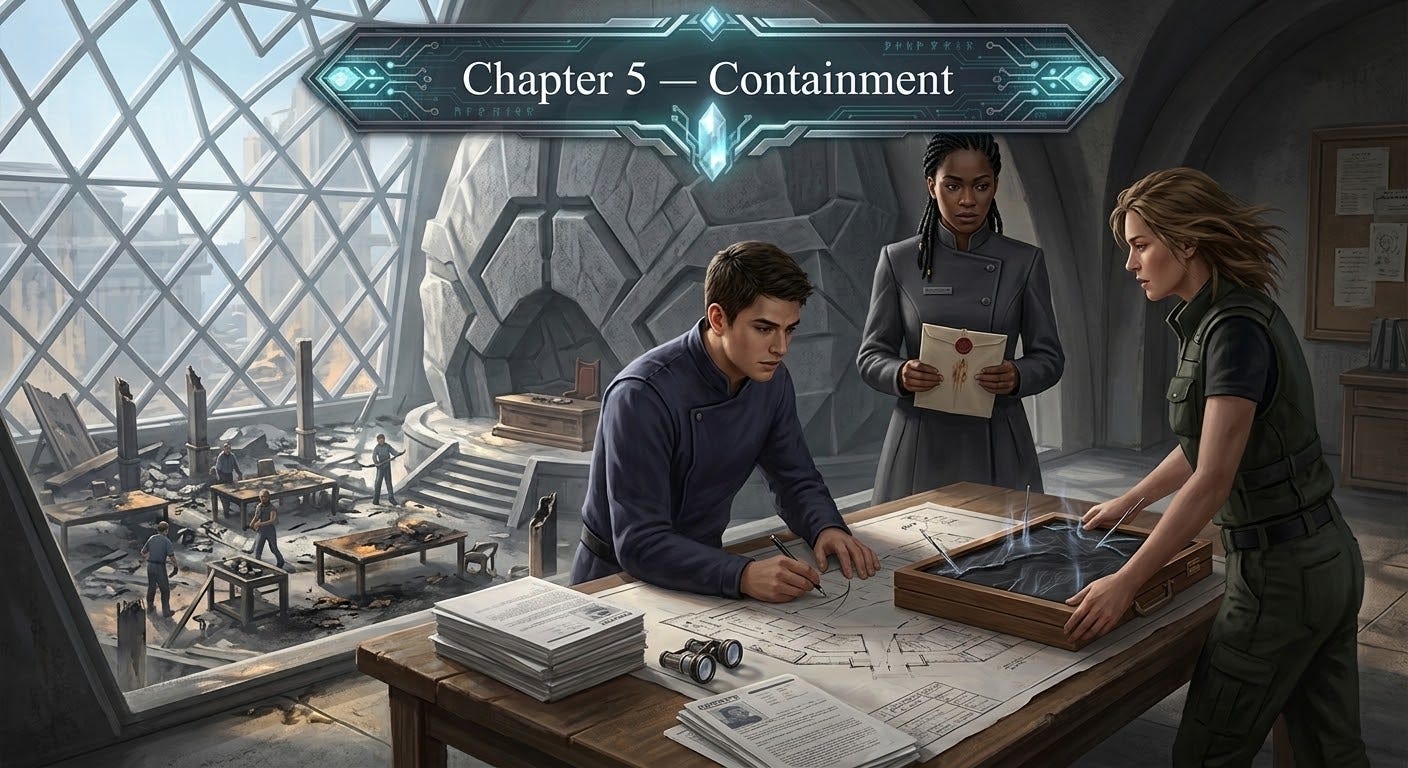
In Chapter 5, "Containment," Sable Rynn, Tarin Kest, and Nera Voss secretly align after discovering that all official guild reports regarding the exchange court disaster omit crucial details. By comparing Sable's pressure measurements with Nera's warrant records, they deduce that an unauthorized fourth relation originated from beneath the court's foundation and that evidence of this fourth mark was deliberately erased from the official records. Neutral archivist Aurel Senn approaches them, offering access to uncataloged pre-Severance historical records, and invites the trio to secretly convene at his archive after dark to piece together the truth behind the system failure.

Read article


CodeBoundNov 6, 2026

CodeBound - Chapter 4: Confluence

Gathered at the neutral city of the Confluence for a ceremonial multi-guild demonstration, Phreaker operator Sable Rynn and Conductor Halden Rusk navigate a tense diplomatic environment where three rival systems—Phreaker, Hacker, and Crypto—coexist under an unsettling, unauthorized fourth harmonic. When the ceremonial execution triggers a catastrophic system-wide feedback loop, turning the entire exchange court into flying glass and white noise, Sable is forced to work alongside Hacker auditor Tarin Kest and Crypto adjudicator Nera Voss to contain the violent resonance and save civilian lives. In the aftermath of the disaster, as the guilds instantly shift to mutual accusations, Sable, Tarin, and Nera realize the failure was systemic and deliberate, leaving them tied to a dangerous mystery while the hidden fourth harmonic continues to vibrate beneath them.

Read article
CodeBoundNov 6, 2026

CodeBound - Chapter 3: The Seal That Signed Itself

When Crypto adjudicator Nera Voss inspects a disputed workshop warrant for a long-dead signer, she discovers an impossible reality: the seal has not only been recently renewed by Orrel Dane, but its authenticated pattern validates a dead identity as currently capable of choosing. When Sealwarden Ysra Pell abruptly confiscates the record under high custody jurisdiction and dismisses Nera's concerns about systemic legitimacy, Nera recognizes a familiar, suppressed three-arc mark hidden inside the warrant—the exact same symbol found on her missing mother's damaged seal. Refusing to let the institutional cover-up stand, Nera recreates the mark in the private archives and discovers it generates an unrequested fourth central relation, confirming that someone is using an old compact to make dead relationships answer as living ones. Slipping the hidden impressions into her travel coat, Nera joins the official Crypto procession toward the neutral city's three-guild Confluence, determined to uncover the truth the guilds have agreed to forget.

Read article
CodeBoundNov 6, 2026

CodeBound - Chapter 1: The Wrong Note

While calibrating the carrier tower's resonance network three days before the Confluence, Phreaker tuner Sable Rynn detects an anomalous fourth harmonic with a stuttered rhythm that she instantly recognizes from the emergency relay during the corridor collapse that allegedly killed her brother years ago. When her mentor, Halden Rusk, arrives and abruptly orders her to record the tower as stable, lie to the guilds, and drop her investigation to prevent a catastrophic panic, Sable realizes the official narrative of her brother's death was a cover-up. Choosing to conceal a fractured, vibrating tuning shard from the debris site in her boot rather than obey, Sable resolves to carry the lie into the upcoming three-guild gathering and finally track down the true source of the forbidden sound.

Read article
Architecting IntelligenceNov 6, 2026

Architecting Intelligence - Chapter 2: The Agentic Ecosystem

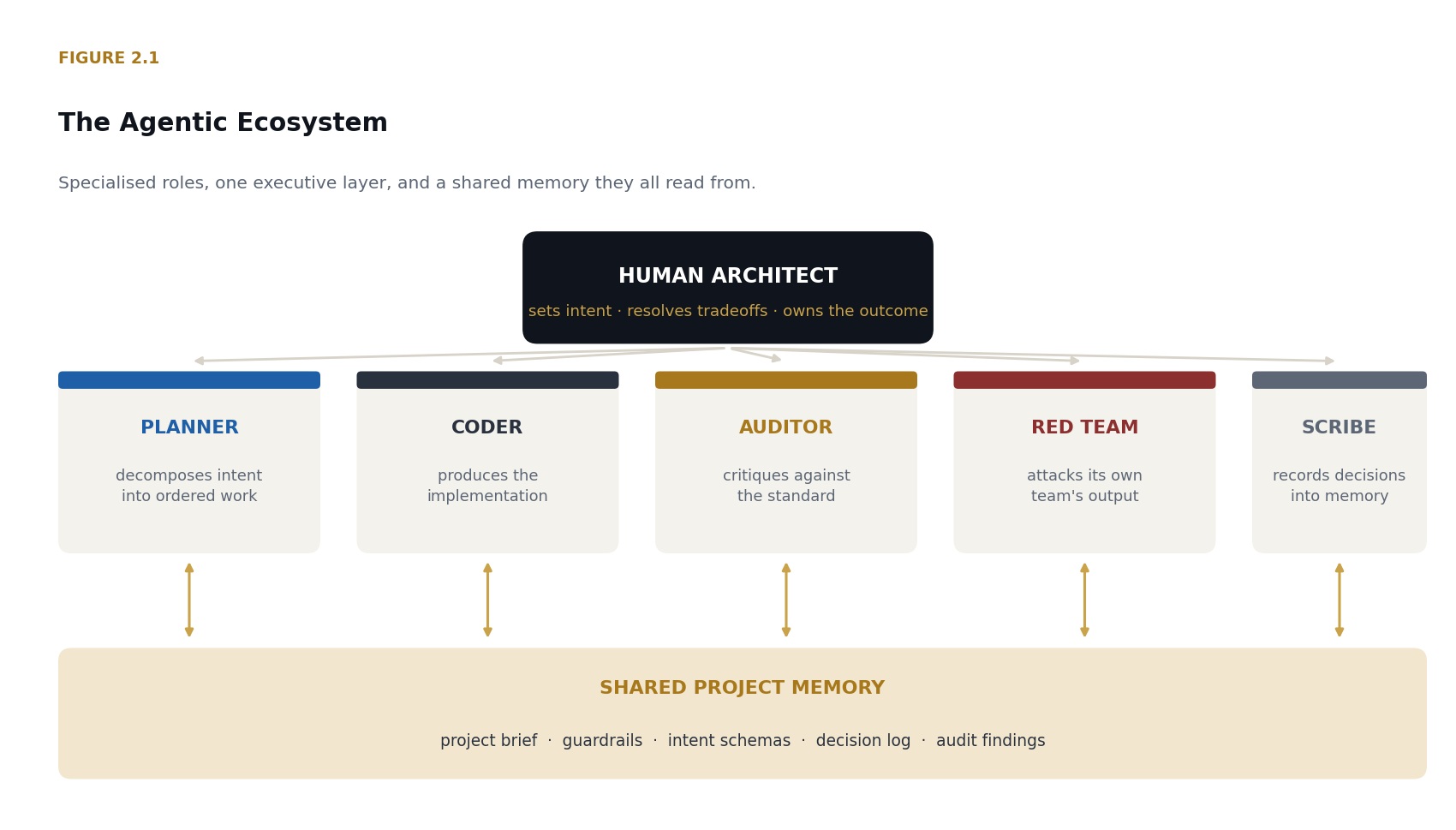
Transitioning from a single, all-in-one AI model to an agentic ecosystem mirrors human engineering organizations by dividing complex software development among specialized roles like researchers, architects, coders, and auditors. While specialization eliminates the cognitive interference of context-switching and drives higher code quality through deliberate adversarial friction, it introduces coordination challenges that make a shared, persistent project memory essential. Ultimately, because humans remain the accountable executive layer responsible for setting goals and vetting tradeoffs, the developer's role evolves from writing line-by-line syntax to managing an orchestrated team of intelligent agents.

Read article
Architecting IntelligenceNov 6, 2026

Architecting Intelligence - Chapter 3: Memory Routing and Context

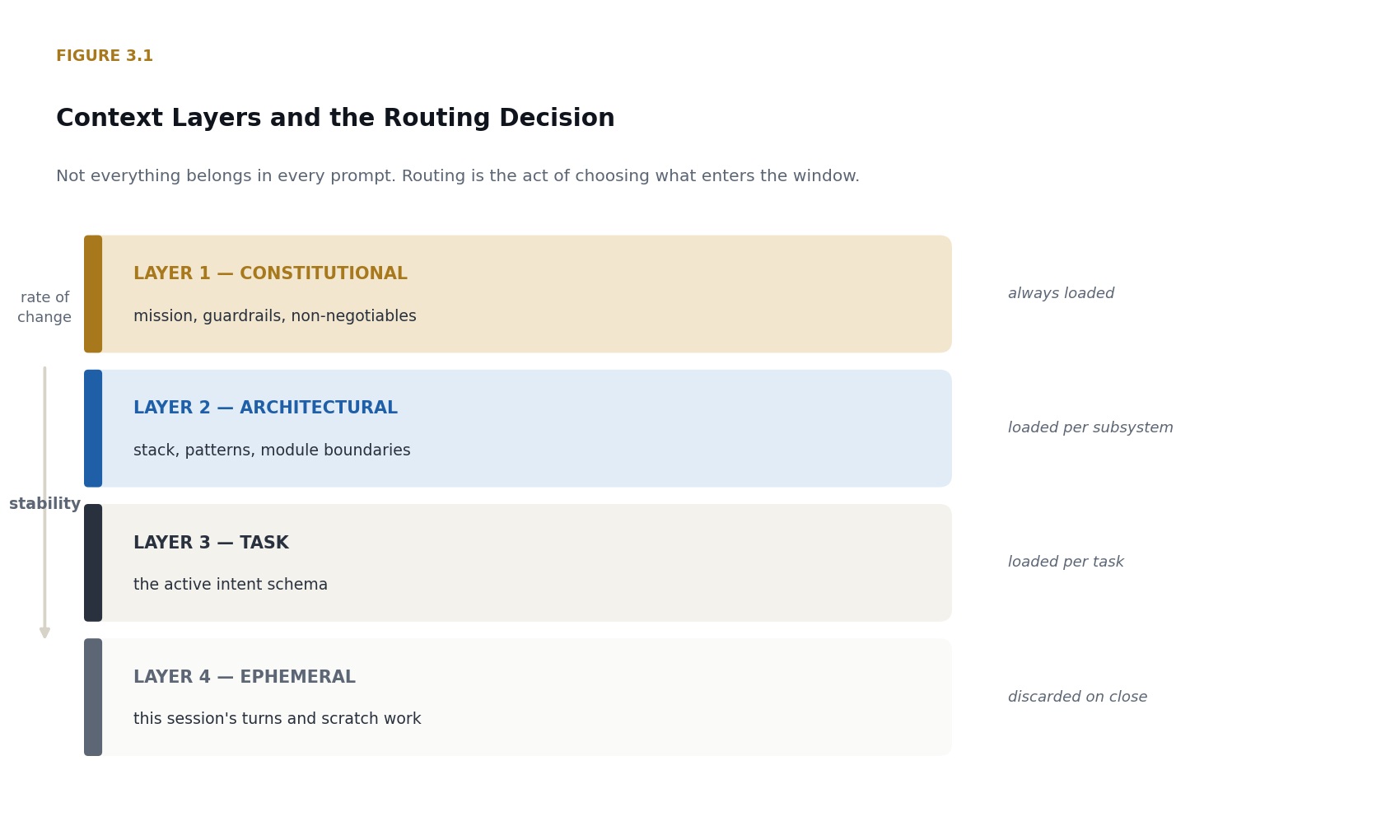
Chapter 3 demonstrates that memory is the foundational prerequisite for true artificial intelligence, exposing context window limitations and statelessness as the core bottlenecks preventing models from operating as persistent systems. Rather than treating memory as a simple chat history or prompting trick, the text details how stateful persistence—spanning short-term working context, long-term vector storage, and structured knowledge graphs—transforms ephemeral LLMs into coherent, evolving infrastructure capable of maintaining architectural integrity across sessions. By establishing mechanisms for agents to record, query, and reconcile past decisions without falling into cognitive drift or context saturation, memory shifts software development from fleeting text generation to stable, long-term system execution

Read article
Architecting IntelligenceNov 6, 2026

Architecting Intelligence - Chapter 1: The End of Syntax

Tracing computing history through seven decades of raising abstraction—from manual wire-toggling and assembly to modern high-level frameworks—reveals that natural language represents the natural endpoint of software evolution by eliminating syntax as a translation middleman. Rather than diminishing developer value, this shift from imperative coding to declarative intent relocates human precision from memorizing language rules to specifying structural requirements, defining system constraints, and evaluating architectural trade-offs. As models absorb the labor of translating intent into execution, the economic bottleneck of software shifts from implementation speed to conceptual clarity. Consequently, the modern developer evolves from a code-writing typist into a system architect, where ultimate success depends entirely on the precision of human thought and the rigor of constraint specification rather than syntax mastery.

Read article
CodeBoundSep 30, 2026

CodeBound - Chapter 2: A Form Without an Author

When Hacker guild auditor Tarin Kest witnesses a sanctioned civic form fail—causing an old floodgate to violently slam back after missing a crucial identity-continuity clause—he inspects the loop and discovers two inexplicable fields that match a secret, copied crystal fragment in his possession. Despite Tarin pointing out that these unexplainable fields appear in every inheritance pattern, Architect Edrin Korr orders him silent and assigns the incident to operator error, a blame officialized by the civic board later that evening. Realizing the official report conceals a fundamental truth and eager to compare crystal patterns across disciplines before Edrin can erase the evidence, Tarin packs his private notes and quietly leaves before dawn as the three-guild Confluence begins.

Read article
ZeroDriveX Blog — Engineering, Security, Signals & Series