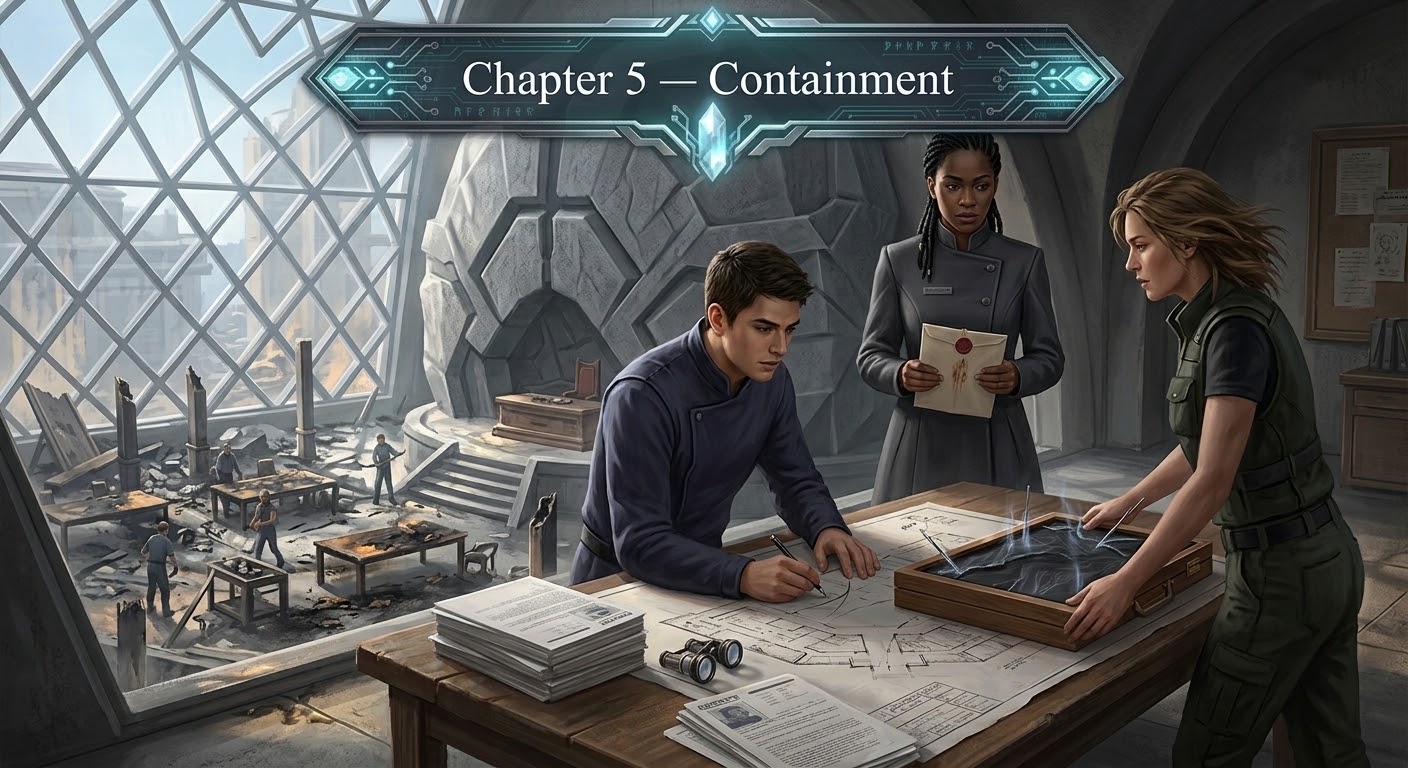
CodeBound ——— Chapter 5: Containment
By ZeroDriveX
September 25, 2026
By sunrise, the Confluence had produced nine official accounts of the disaster.
Tarin had read all nine.
The Phreaker report blamed a malformed return condition. The Crypto report blamed unauthorized carrier interference. The neutral stewards blamed “compound procedural deviation,” a phrase broad enough to include weather, treason, and poor furniture placement.
The Hacker account was only six lines long.
It blamed the ceremonial cantor.
Tarin set the pages into three precise stacks and resisted the urge to arrange them by degree of dishonesty.
The investigation chamber overlooked the ruined exchange court through a wall of clear lattice. Below, workers moved among scorched tables and broken carrier posts. The central dais remained sealed beneath a gray containment shell of Hacker design.
His design, technically.
That was why Architect Edrin Korr had ordered him to produce the definitive structural account before noon.
Document the sequence, Edrin had said. Establish the initiating fault. Exclude speculation.
The instruction contained its own conclusion. Tarin admired its efficiency.
He unfolded a plan of the court and marked the first confirmed event: duplicate carrier signal entered the ceremonial column.
The door opened without permission.
Sable Rynn came in carrying a wooden case under one arm and the expression of someone who considered doors an administrative suggestion. “No,” Tarin said.
She closed the door behind her. “Good morning to you too.” “This chamber is restricted.”
“So was the court after the roof began falling. Restrictions had mixed results.” “You cannot participate in a Hacker inquiry.”
Her eyes dropped to the nine reports. “Then it’s lucky this disaster involved more than Hackers.”
Tarin put down his pen. “Who authorized you?” “My measurements did.”
“That is not how authorization works.” “Yes, the woman from Crypto mentioned something similar while saving all of us.” Sable placed her case directly on top of the neutral reports. Tarin moved it six inches left, where it no longer obscured the page headings.
She moved it back.
He looked at her.
She smiled.
There were people who created disorder accidentally and people who cultivated it as proof of life. Tarin had known Sable for less than a day and was already confident which kind she was.
“The carrier duplicated before the formalist committed the transformation,” he said. “Your guild’s own record confirms it.”
“My guild’s record confirms a second signal appeared. It does not say we produced it.”
“A distinction without evidence.”
“Evidence is why I’m here.”
She opened the case.
Inside lay three tuning needles, a field resonator, and a sheet of thin black membrane stretched over a brass frame. Sable set the frame above the court plan and touched one corner. Pale ridges rose across its surface.
“A pressure record,” Tarin said.
“A carrier map.”
“It records pressure over time.”
“And a door is a wall with ambition. Names matter.”
He leaned closer despite himself.
Three primary wave paths crossed the membrane: the cantor’s intended signal, the western relay response, and the echo that had entered half a beat late. The third path was faint but continuous. It did not originate at the Phreaker post. It rose simultaneously from six points around the dais.
Tarin adjusted his inspection lens. Sable slapped his hand away from the frame.
“Do not put structural glass against a live membrane.”
“It is no longer live.”
“It remembers being live.”
“That sentence means nothing.”
“It means your lens will flatten the phase differences and destroy the only useful measurement in this room.”
He looked from her to the membrane. “You can prove that?”
She touched two tuning needles to opposite corners. A low tone passed between them. Where Tarin’s lens had approached, the smallest ridge bent toward the brass edge.
He removed the lens.
Sable’s triumph was immediate and irritating.
“You were saying?”
“That your equipment is excessively delicate.”
“Your apology overwhelms me.”
Tarin studied the six origin points. They aligned with the buried joints of the dais, not any visible carrier node.
“The echo emerged inside the lattice.”
“Yes.”
“That is impossible.”
“I keep hearing that from people immediately after impossible things happen.”
He ignored her. “If the second signal entered from the foundation, the formalist received two valid carrier inputs. His structure transformed both.”
“And reversed one.”
“The return condition was not reversed. It attached to the second input before the first transformation completed.”
Sable tilted her head. “That sounded like a difference designed to make a Hacker feel better.”
“It is the difference between a malformed form and a correct form applied to an undeclared state.”
She stopped smiling.
Tarin traced the sequence on his plan. Her measurements supplied timings the official records lacked: the echo, the formalist’s hesitation, the authorization pulse, the first structural inversion.
His containment had succeeded because Sable’s carrier path had arrived inside the narrow interval between two state changes. He had believed he defined that interval.
He had not.
She had heard it.
“You adjusted before I completed the corridor,” he said.
“You took too long.”
“I spoke seven words.”
“Very slowly.”
“They were structurally necessary.”
“So was moving the child before the next cutting band.”
“You could not have known the width I intended.”
“You could not have known where the pressure would break.”
They faced each other across the table.
Both statements were true. Tarin disliked problems with more than one correct answer.
Sable looked down first, but only because the membrane had begun to tremble. “Your boundary gave my signal somewhere to go.”
“Your signal placed my boundary where it could hold.”
The admission changed the room by a fraction.
Sable closed the case halfway. “Careful, Auditor. Someone might mistake that for respect.”
“Then please keep it confidential.”
The door opened again.
Nera Voss entered after waiting exactly long enough to demonstrate that she had heard the exchange and would not acknowledge it. She carried a sealed evidence folio against her chest. Unlike Sable, she paused at the threshold.
“Am I authorized to enter?”
“No,” Tarin said.
“Yes,” Sable said at the same time. Nera considered them. “An admirably unified procedure.” She entered and placed the folio beside the carrier map, avoiding every report without appearing to look.
Tarin indicated the seal. “High custody released the ceremonial record?” “High custody released selected readings.” “Selected by whom?” “Sealwarden Pell.”
Sable made a sound low in her throat. “Then we have all the truth she found convenient.”
Nera’s expression remained composed. “That is not what I said.”
“No. You people have customs for not saying things.” Tarin opened the folio. Inside were three warrant impressions taken before, during, and after the ceremony. The first showed the intended authorization: three authenticated contributors, one bounded transformation, one minute of persistence.
The second was scorched through its center.
The third should have been blank after Nera’s revocation. It was not.
A faint authorization chain continued beyond the broken edge of the ceremonial warrant, attached to no visible identity.
Tarin held the sheet toward the window.
“The containment was accepted,” he said.
Nera watched him rather than the impression. “Temporarily.” “By whose warrant?”
“The record does not establish that.”
“The record establishes something.” “It establishes that the lattice treated your containment as permissible.”
Sable leaned over his shoulder. Her hair brushed his sleeve, bringing the scent of rain and hot crystal. Tarin shifted half a step away and found the movement more noticeable than remaining still would have been.
“The pulse changed when we joined it,” Sable said.
Nera’s gaze sharpened. “Joined what?”
“My carrier and his form.” “You described that in your report as coincident action.” “My report was written with Halden Rusk standing close enough to correct my breathing.”
Nera looked at Tarin. “My report calls it an emergency containment,” he said.
“That is not an answer either.” “No. It is the phrase Edrin permitted.”
For the first time, the three of them occupied the same silence rather than competing to fill it.
Tarin laid Sable’s membrane beside Nera’s second impression. The six origin points in the carrier record matched six small distortions around the warrant’s outer relation. Not perfectly. Five aligned. The sixth had no corresponding mark.
Or rather, its mark had been removed. The vellum fibers near the lower edge ran in the wrong direction. Someone had lifted an impression from the surface after it was made.
Tarin turned the sheet toward Nera. “What was here?”
Her eyes moved to the damaged fibers, then back to him. “A heat artifact.”
“No. Heat contracts across the grain. This was separated along it.”
“The seal plate fractured.” “After the impression formed.”
Sable looked between them. “For those of us raised without a romantic attachment to paperwork?” “A reading was removed,” Tarin said.
Nera’s attention cooled. “That is an accusation.”
“It is an observation.”
“Observations become accusations when spoken to people with authority.”
“Then tell us before someone with authority arrives.”
The corner of Nera’s mouth moved. Not a smile. An acknowledgment of a competent strike.
She placed one finger over the missing region. “The ceremonial warrant named three contributors.”
“We know,” Tarin said.
“It also registered a fourth relation.”
Sable’s hand went still on her case.
“What relation?” Tarin asked.
Nera withdrew her finger. “I could not authenticate it.” “That was not my question.”
“It is the answer I can support.” The distinction was deliberate. Nera had given them enough to confirm concealment while withholding the nature of the mark.
Tarin recognized the strategy because he had used its structural equivalent for years: reveal the boundary, hide what it protected. “You copied it,” he said. Sable looked at him. Nera did not. That was answer enough. A soft knock came from the outer door. All three turned.
An older man stood beyond the clear panel, silver-haired and carrying no guild insignia. His clothes were plain, his posture patient. Neutral archivist Aurel Senn had mediated two border settlements and written the only publicly available study of early Confluence architecture.
He waited for an invitation.
Nera opened the door.
“I wondered how long it would take you to put the records beside one another,” Aurel said.
Sable closed her case. “You were watching us?”
“I was watching three guild delegations ensure that their evidence remained separate. You were the exception.”
Tarin moved the warrant impressions beneath the neutral reports. The gesture was pointless; Aurel had already seen enough. “What do you want?” he asked.
“To prevent yesterday’s failure from becoming tomorrow’s war.”
“A modest morning project,” Sable said.
Aurel’s smile carried weariness rather than offense. “The official inquiries will produce three technically defensible explanations. Each will omit the facts that require another guild’s knowledge. By the time the councils compare them, if they ever do, the omissions will have hardened into doctrine.” Nera studied him. “You have access to records outside guild custody.”
“I maintain the neutral pre-Severance collection.”
Tarin felt the forbidden crystal fragment like a second pulse inside his travel case.
Most of Aurel’s collection was believed to be ceremonial debris: incomplete marks, broken forms, carrier annotations copied by people who had not understood them. Public catalogs contained almost nothing useful.
“You have uncataloged material,” Tarin said. “I have material that cannot be cataloged honestly under one guild’s vocabulary.” Sable reopened her case by an inch. “Does any of it sing?”
“Some of it was designed to be heard.”
Nera’s eyes moved to Aurel’s hands. “What authorization governs access?”
“Mine, within neutral custody.”
“And what do you require in return?”
Aurel looked at each of them before answering. He did not rush the pause or use it to assert rank. He seemed genuinely interested in whether they would refuse.
“Bring your complete records,” he said. “Not your guild reports. What you actually observed. Compare them in my archive, outside your command channels.”
Sable’s laugh was quiet. “That sounds very much like treason.” “Only if the truth belongs to your superiors.” Tarin disliked the line because part of him wanted to admire it.
“When?” he asked.
Nera glanced at him. Aurel named an hour after dusk and an archive entrance beneath the northern bridge. “Come separately. Decide for yourselves whether to enter.” He left without asking for agreement.
Through the clear wall, Tarin watched him cross the damaged court. Neutral workers gave him room without being told. Sable secured the latches on her case. “He is either the first useful adult here or exceptionally good at sounding like one.”
“Those categories overlap,” Nera said.
Tarin returned the warrant impressions to their folio. The removed reading remained visible now that he knew where not to look.
“We should not trust him,” he said.
“No,” Sable agreed. Nera sealed the folio. “Trust was not what he requested.” Outside, crews began lifting the containment shell from the ruined dais.
The three of them watched it rise.
Beneath the shell, the crystal column remained cracked from base to crown. At its center, something pale flickered once and disappeared.
Tarin reached for his notebook.
Sable reached for her tuning case. Nera reached for the seal folio. None of them commented on the timing.
After dusk, they would compare what their guilds had ordered them to keep apart.