BOOK · BY JUSTEN VANNOCKER
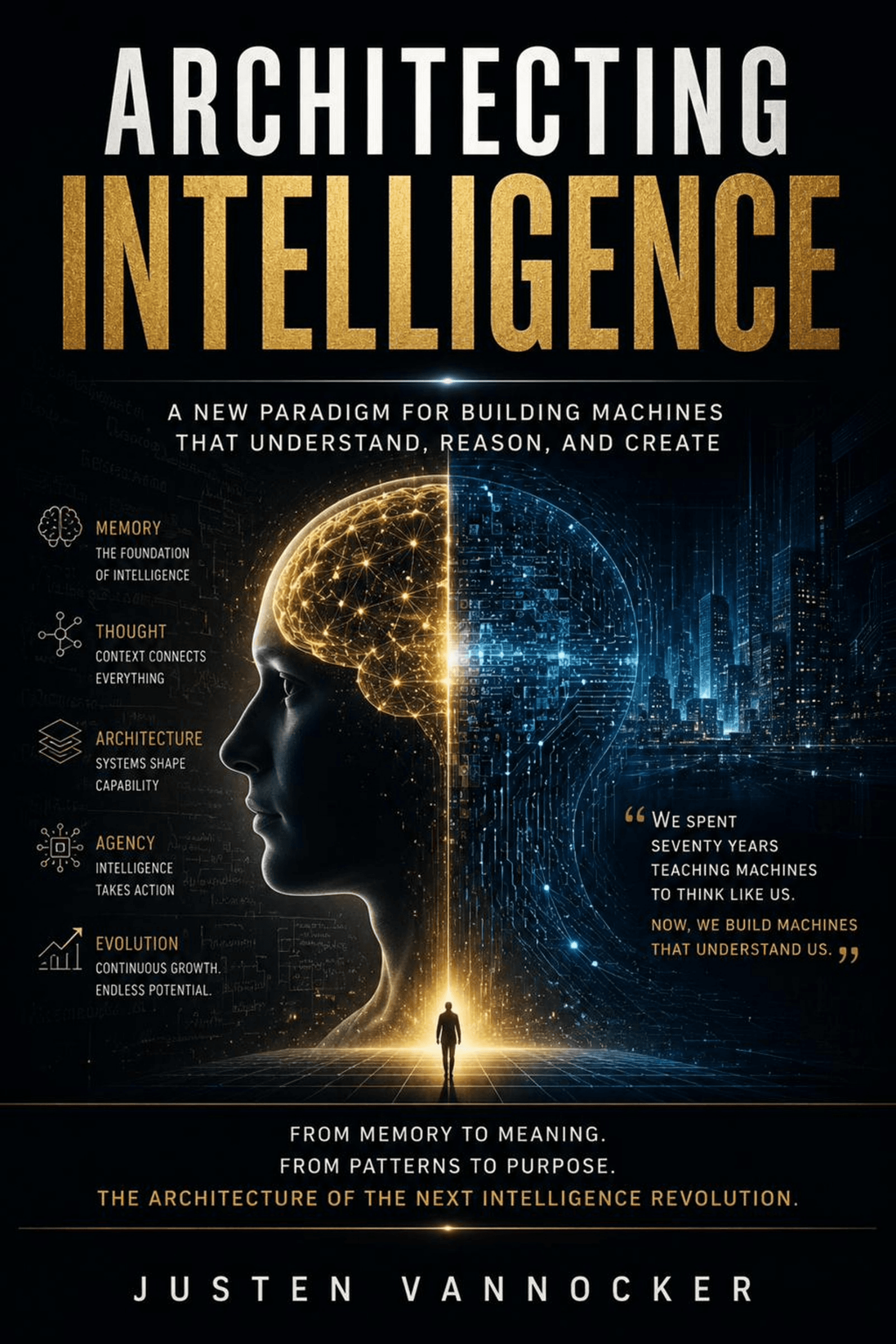
Architecting Intelligence
Build systems that remember.
Current AI systems can reason impressively inside a session, yet much of their capability disappears when context is lost. Architecting Intelligence examines what changes when memory, intent, specialized agents, auditing, and evidence become architectural components rather than afterthoughts.
Chapter 1 — The End of Syntax
Why natural language is not a new programming language but the removal of one — and what that relocates rather than eliminates.
Every major leap in computing has raised the level of abstraction. We moved from physical wiring and machine code to assembly, high-level languages, managed runtimes, frameworks, and cloud platforms. Each step removed a category of translation work and brought the developer closer to expressing the outcome they actually wanted.
Natural language is the next step. The important change is not that English replaces Python or Rust. It is that syntax stops being the primary interface between an idea and its implementation. Code increasingly becomes a generated artifact downstream of a specification.
That does not remove precision. It relocates it. Instead of spending most of our precision budget on syntax, method signatures, boilerplate, and language ceremony, we have to become precise about intent: guarantees, constraints, failure conditions, security properties, performance requirements, and tradeoffs.
The hard part of software was never typing the code. It was deciding what the code should do.
The developer therefore does not disappear. The role moves upward. Defining requirements, identifying constraints, auditing what was produced, and choosing among architectural tradeoffs become more important as implementation gets cheaper.
This changes software economics as well. When implementation costs fall, experimentation becomes cheaper. Teams can test several product directions where they once had enough engineering capacity to commit to one. The scarce resource shifts from the ability to express code toward the ability to decide what is worth building and specify it correctly.
Chapter takeaway
Natural language removes a translation layer. Precision does not disappear with syntax; it moves from the expression of instructions to the specification of intent.
Try it — The Translation Audit
Take the last non-trivial function you wrote. Before reading its code, describe in plain language what it must guarantee and what must never happen. Then compare that specification with the implementation. Every important behavior present in the code but absent from your prose is an assumption that existed only in your head. Capture those assumptions: they are the beginning of a real constraint list.
Chapter 2 — The Agentic Ecosystem
One model is a tool. Several specialized models with defined roles and shared memory are something closer to an engineering organization.
The common picture of AI development is a single model doing everything: product management, architecture, implementation, security, operations, and QA. Human engineering organizations learned long ago why that structure fails. Complex systems benefit from specialization and independent perspectives.
The same principle applies to agentic systems. An agent is more than a chat window: it can be given a defined role, objectives, tools, constraints, and access to the memory relevant to its responsibility. The underlying model may even be the same; the role, brief, constraints, and memory are what create specialization.
A Researcher can reduce uncertainty before implementation. An Architect can turn evidence into boundaries and interfaces. A Coder can implement against that blueprint. Security and audit roles can evaluate the result from perspectives deliberately separated from the implementation pass.
This separation matters because a single reasoning context asked to optimize architecture, security, UX, performance, and implementation simultaneously is forced to continually shift priorities. Specialized agents can instead optimize their own domains and pass structured work between roles.
Roles, not models: specialization comes from the brief, constraints, tools, and memory each agent receives.
The larger argument of the book follows from here: if agents are going to function as persistent collaborators rather than disposable tools, the system needs a way to retain decisions, evidence, contradictions, guardrails, and accumulated knowledge across work. That is where architecture begins to matter more than the model alone.