The Rate, the Mine, and the Unsaid Future
Listen to this article
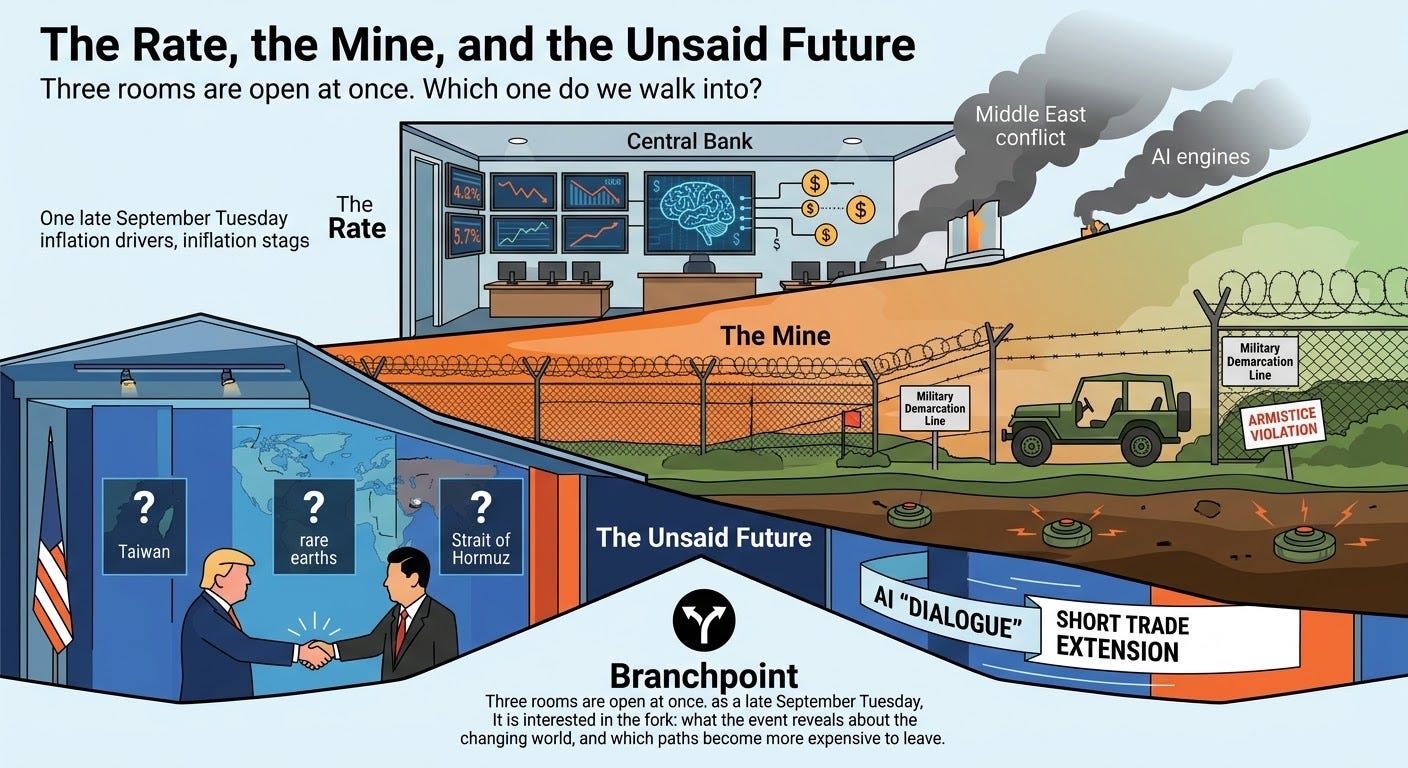
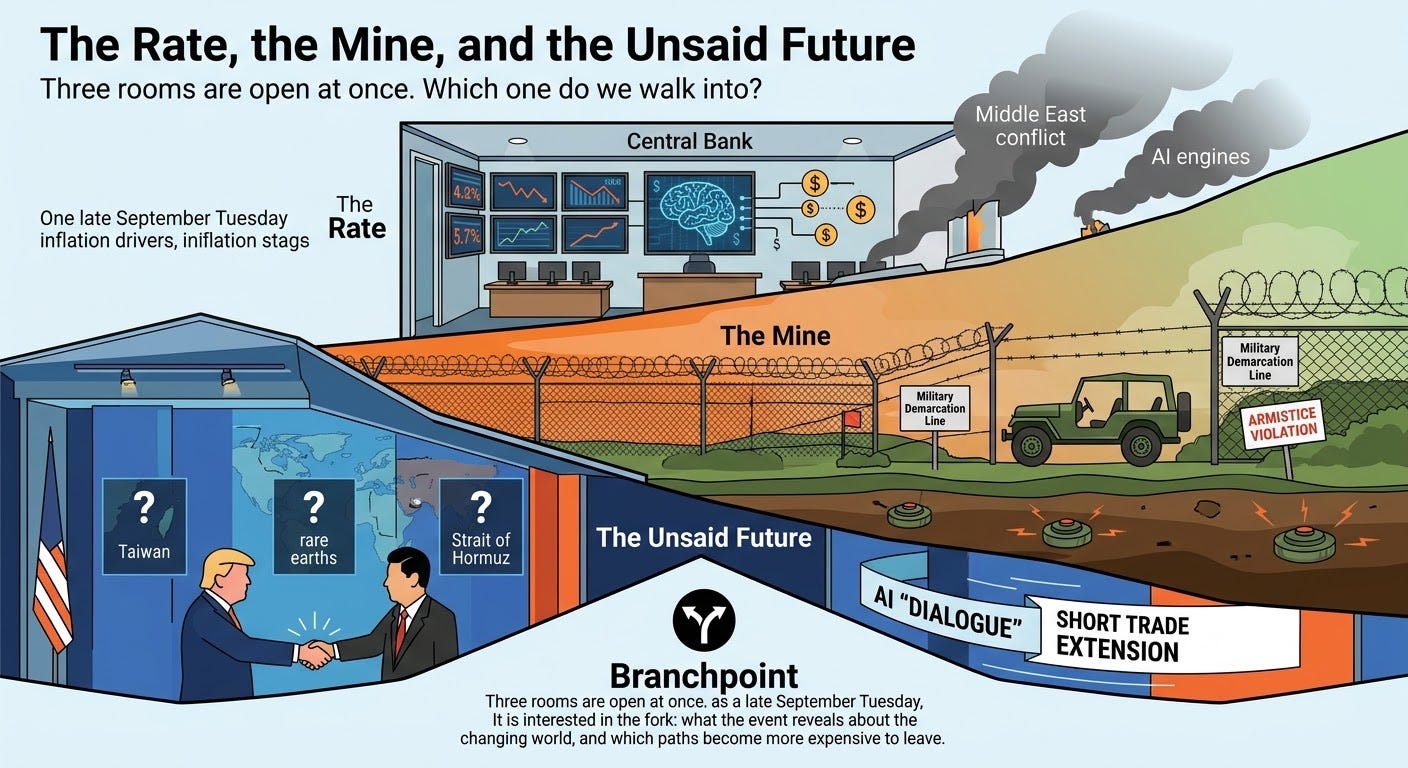
A Tuesday in late September does not arrive as a single story. It arrives as three high-leverage events running in parallel: a central bank naming artificial intelligence and a Middle East war as inflation engines; a minefield south of the Military Demarcation Line that Seoul now treats as an armistice violation; and the aftertaste of a Trump–Xi summit that produced pageantry, a short trade extension, and an AI “dialogue” while leaving Taiwan, rare earths, and the Strait of Hormuz only half-spoken.
Branchpoint is not interested in the headline as a finished object. It is interested in the fork: what the event reveals about the changing world, and which paths become more expensive to leave.
The Event
- Australia’s cash rate at 4.60%.
The Reserve Bank of Australia lifted its cash rate 25 basis points to 4.60 percent — a 15-year high — in a unanimous vote. The statement is unusually explicit: inflation is still too high; upside risks flagged in August are materializing; the Middle East conflict has broadened and energy prices are higher than assumed; AI-related demand is driving rapid growth in global prices for technology goods. Governor Michele Bullock framed the Middle East impulse as additive to domestic capacity pressure, not a substitute for it, and left the door open to further hikes even if that means a sharper slowdown.
Directly involved: the RBA board, Australian mortgage holders, energy importers, data-center and chip-adjacent supply chains. Indirectly: every commodity exporter in the Pacific, every central bank still pretending AI capex is disinflationary on a short clock, and households already carrying three prior 2026 hikes. Backing the hawkish read: hotter July core, fuel pass-through, and officials who visited the U.S. and came home more worried about the AI investment frenzy.
- North Korean mines in the southern DMZ.
South Korea’s defense minister Kang Shin-chul told parliament that North Korean resin anti-personnel mines caused last week’s explosions that injured South Korean soldiers south of the Military Demarcation Line. A joint probe with the United Nations Command found additional devices. Seoul calls it an armistice violation and says corresponding measures will come “in stages.” The 2015 precedent is loud: mines, loudspeakers, a standoff, then a deal. This time the peninsula sits inside a wider 2026 security weather system — Iran war, U.S.–China theater management, and a White House that just hosted Xi.
Directly involved: ROK Ministry of National Defense, UNC, KPA units that fortified the border. Indirectly: Japan, U.S. Forces Korea, Chinese diplomats who prefer a quiet peninsula while energy and AI talks run, and domestic South Korean politics that reward visible toughness.
- The Trump–Xi residue.
Last week’s Washington summit extended a trade truce into early January, sketched $30 billion-ish of “non-sensitive” tariff relief each way, floated U.S. coal purchases, stood up an AI dialogue and an incident channel, and produced dueling readouts on Taiwan. Alignment language on Iran and international waterways exists; enforcement language does not. The next meetings are already calendared: APEC in Shenzhen, G20 in Miami.
The three events share a spine: energy prices, compute prices, and the cost of a misread signal on a border.
Branch 1 — Managed dual tightening (≈23% convergence on current signals)
What it is.
Australia’s hike is not a one-off. Other small open economies treat AI-hardware inflation and war-premium energy as persistent, not transitory. Rates stay high or go higher into Q4. Seoul answers the mines with calibrated measures — loudspeakers, limited artillery fire exercises, legal/UNC paperwork — without a kinetic spiral. Washington and Beijing use the new AI channel as a pressure valve, not a ceiling on capabilities.
What it means.
Inflation stays sticky in tradable tech and fuel. Real rates stay restrictive in the Pacific. Capital rotates toward energy security and “sovereign compute,” not toward duration. The Korean peninsula becomes a managed irritant rather than a second front.
Who benefits.
Energy majors, LNG shipping, defense-electronics and mine-clearance contractors, holders of short-duration cash, governments that can sell “discipline” to voters.
Who doesn’t.
Highly leveraged Australian households, rate-sensitive housing, emerging-market importers of both oil and GPUs, any peace dividend narrative on the peninsula.
Macro change.
The 2020s inflation regime stops being “COVID hangover + one war” and becomes a two-factor model: conflict calories + AI watts. Central banks that refuse that model lose credibility first.
Branch 2 — Peninsula signaling war inside a commodity shock (≈19%)
What it is.
Seoul’s “measures in stages” skip the loudspeaker chapter and move faster — live-fire near the MDL, partial suspension of remaining inter-Korean arrangements, tighter inspection of North-linked shipping. Pyongyang answers with artillery warning shots or a satellite/missile calendar event. Oil and LNG already elevated by the broader Middle East war get a Northeast Asia risk premia on top. The RBA’s energy assumption looks conservative within weeks.
What it means.
Two security theaters price into the same barrel and the same shipping insurance sheet. AI buildout does not pause; it just gets more expensive. U.S.–China AI talks continue, but every communiqué is read as cover for alliance management.
Who benefits.
Northeast Asian defense budgets, Japanese and Australian energy security hawks, gold and defense ETFs, political actors who campaign on “the border is live.”
Who doesn’t.
Exporters through Busan and Incheon, Korean equities, any diplomacy that needed quiet on the peninsula to keep Hormuz and Taiwan in separate boxes.
Macro change.
Correlation between “East Asian security” and “global energy” tightens. That correlation is the actual story, not any single mine.
Branch 3 — AI-dialogue becomes a real constraint layer (≈12%)
Worth including. The summit created a channel. Channels sometimes become institutions.
What it is.
November’s AI talks produce a narrow incident protocol — not a treaty, a hotline-plus-norms package for frontier-model accidents, military-adjacent autonomy, and export-control friction. Markets treat it as a slight reduction in left-tail U.S.–China tech rupture. Compute still inflates; policy uncertainty around compute eases a notch.
What it means.
The RBA’s “AI goods inflation” stays, but a full decoupling shock is deferred past the January trade-truce date. Taiwan language stays divergent; the channel is about models and incidents, not sovereignty.
Who benefits.
Cloud and foundry names that need predictability more than they need a nationalist premium; diplomats who sell “guardrails.”
Who doesn’t.
Maximalists on either side who wanted the summit to be a clean win or a clean break.
Negative branch — Unpruned dual front (≈7% if not pruned)
How it plays.
Seoul’s staged response lands as humiliation in Pyongyang. A second incident — another mine, a drone, a naval warning — coincides with a bad week in the Middle East energy system. Insurance and bunker costs jump. The RBA (and peers) hike into weakening real activity. Trump–Xi follow-up meetings become photo ops over a market that is already pricing two wars and a capex boom as one inflation object. Domestic politics in Australia and South Korea punish “half measures.” Misread signals stack.
Who it hurts.
Households at the end of the rate chain, Korean SMEs, anyone long “soft landing + AI productivity miracle this year,” and civilians on both sides of the MDL who do not get a vote on branch selection.
Why it is net negative.
It converts two containable control problems (a minefield, a price level) into a correlated geopolitical-financial event. Precursors: a second confirmed emplacement south of the MDL; ROK measures that skip the 2015 playbook; a Hormuz or Gulf shipping week that rhymes with a Korean live-fire week; official language that treats AI inflation as “someone else’s supply shock” rather than a domestic demand fact.
Chain that raises the odds: mine confirmation → staged military response → North Korean demonstration → energy spike → another Pacific hike → risk-off that forces politicians to look strong rather than precise.
The useful discipline is not to pick a winner on Tuesday morning. It is to notice that the same week priced watts, barrels, and tripwires as one system. Central banks have started saying the quiet part: AI demand and a broadened Middle East war are not footnotes to the forecast. They are the forecast. The peninsula is reminding everyone that armistice lines are also balance-sheet lines.
The branch that gets pruned is rarely the loudest one. It is the one someone decides is too expensive to leave open.
Sponsored by ZeroDriveX