Architecting Intelligence - Chapter 2: The Agentic Ecosystem
Listen to this article
One model is a tool. Several specialised models with defined roles and a shared memory are something closer to an engineering organisation.
“The future is not one artificial intelligence replacing a programmer. It is many specialized intelligences collaborating like an elite engineering team.”
Introduction: Beyond the Single Model
When most people imagine AI-assisted development, they picture a single, god-like chatbot writing code from start to finish. This is the equivalent of expecting one person to simultaneously serve as the product manager, software architect, backend developer, frontend developer, DevOps engineer, security specialist, and QA tester. Any experienced engineering leader knows how that experiment ends: burnout, blind spots, and a system that reflects one person’s biases rather than a team’s collective rigor.
While theoretically possible, asking a single model to wear every hat is incredibly inefficient. Human organizations evolved specialization because expertise compounds. A database expert views a system through a different lens than a UX designer, and a security engineer asks questions a backend developer might never consider. Specialization isn’t bureaucratic overhead — it’s how complex systems stay correct.
The same principle applies to Large Language Models. Modern development is moving away from the “all-in-one” model and toward the Agentic Ecosystem — a system of specialized agents working in concert. An agent isn’t just a chatbot; it is an LLM assigned a defined role, specific objectives, access to dedicated tools, and clear responsibilities. We aren’t replacing software teams; we are recreating their structure at machine speed.
From Tools to Teammates
Traditional software tools are passive. A compiler waits for a command; a linter waits for a file; a test runner waits to be invoked. They have no memory of yesterday’s decisions and no opinion about tomorrow’s direction. Agentic systems, however, are proactive. They possess objectives, maintain their own context, and communicate with each other.
In this ecosystem, agents behave like teammates rather than utilities. One agent might be responsible for gathering technical requirements, another for sketching the architecture, and a third for auditing security vulnerabilities. By distributing the workload, the system avoids the “cognitive interference” that occurs when a single model tries to switch between high-level architectural design and low-level syntax implementation within the same reasoning pass. Just as a human engineer produces worse output when constantly context-switching between strategic thinking and detail-oriented debugging, a single LLM instance produces less reliable output when forced to hold every responsibility simultaneously.
Why Specialization Matters
General intelligence is powerful, but specialized intelligence is scalable. When you ask a single model to design a payment platform, handle offline synchronization, ensure regulatory compliance, and write documentation — all within the same conversation — it has to constantly shift its focus. Security needs often compete with usability requirements; performance needs compete with code readability. A model juggling all of these concerns at once will inevitably under-serve some of them, the same way a human developer pulled in five directions produces mediocre results across all five rather than excellence in any one.
Specialized agents eliminate this friction. Each agent optimizes for its own domain while trusting others to handle theirs. The result is a system that mimics a high-performing engineering organization, where every decision is vetted by someone — or something — whose only job is to care about that specific detail. A Security Agent doesn’t need to worry about whether the UI is intuitive. A UX Agent doesn’t need to worry about whether the database schema is normalized. This separation of concerns is not a limitation; it is the entire point.
The Core Agent Roles
While every project is different, mature ecosystems generally converge on a few foundational roles:
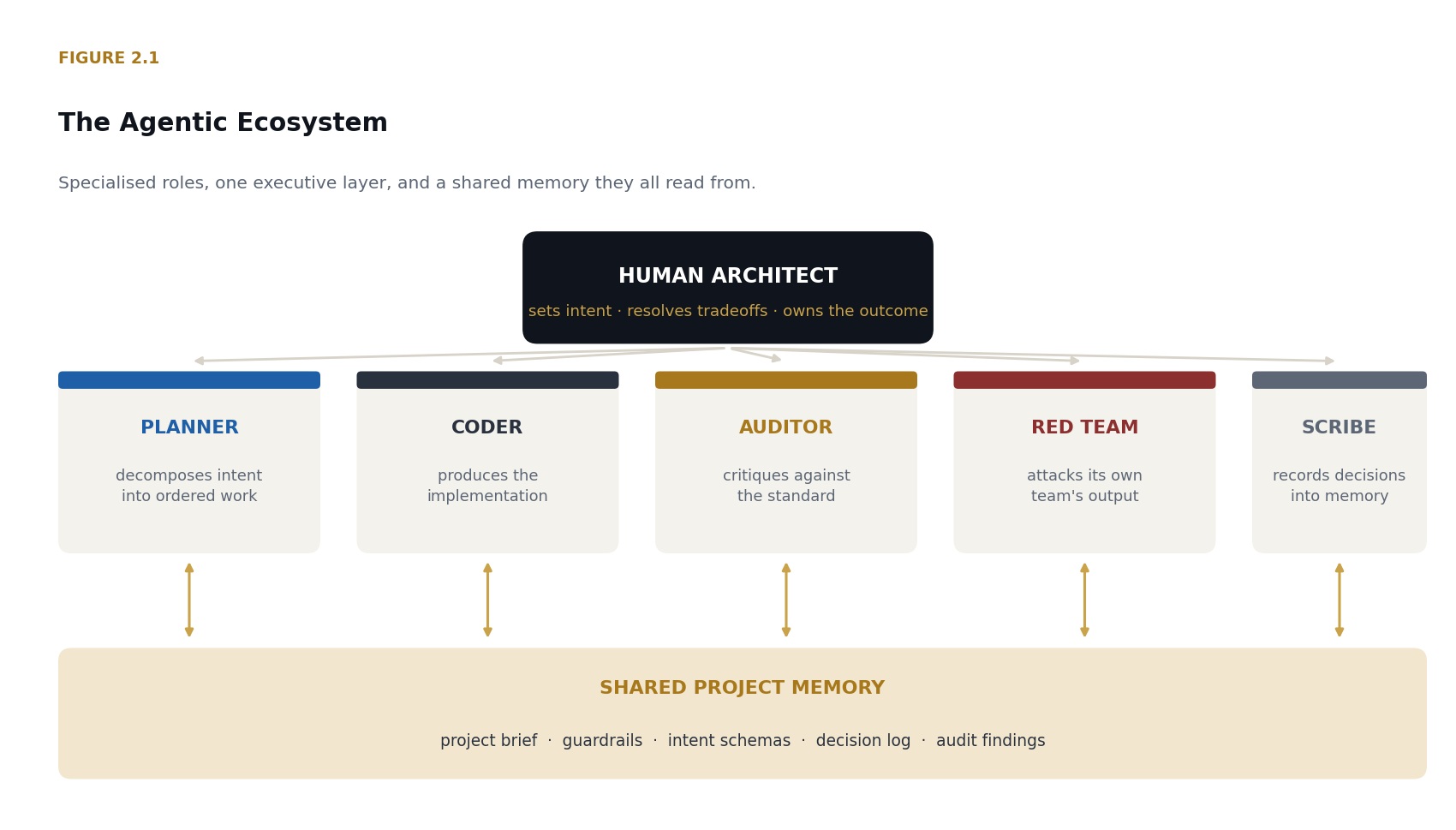
Figure 2.1 — Roles, not models. The same underlying model can occupy any of these seats; what makes them distinct is the brief, the constraints, and the memory each one is given access to.
The Researcher. Before code is written, the Researcher reduces uncertainty. It gathers documentation, compares API capabilities, and checks for library deprecations. It provides the evidence-based foundation for the project. Without a Researcher, later agents are forced to guess at facts — which library version is current, which API is deprecated, which approach the ecosystem has already converged on — and those guesses compound into architectural mistakes downstream.
The Architect. This agent transforms the Researcher’s findings into a structural blueprint. It defines service boundaries, interface contracts, and how data should flow between components. Without an Architect, AIgenerated code quickly devolves into a collection of disconnected, inconsistent snippets — each individually reasonable, but collectively incoherent. The Architect is the agent responsible for the shape of the system as a whole, not any individual piece of it.
The Coder. This agent turns the blueprint into reality. It doesn’t guess the direction; it executes the plan provided by the Architect. It focuses purely on implementation, refactoring, and following established conventions. A well-scoped Coder agent is disciplined precisely because its job has been narrowed: it is not responsible for deciding what to build, only for building it correctly according to the spec it has been handed.
The Auditor. In human teams, code quality is maintained through review. The Auditor is the skeptic. It doesn’t write code; it challenges it. It looks for security flaws, architectural drift, and missing edge cases. An effective Auditor assumes the Coder made a mistake and searches for it relentlessly — not out of malice, but because that adversarial posture is what catches the errors a more agreeable reviewer would miss.
As a project matures, you can introduce specialized agents like the Security Agent (focused on attack surfaces), the Testing Agent (focused on coverage), or the UX Agent (focused on accessibility and interaction design). There is no fixed ceiling on how granular this specialization can become; the right number of agents is whatever number reduces cognitive overload without introducing unnecessary coordination cost.
Communication is the Limiting Factor
Adding more agents doesn’t automatically improve results; it often creates more noise. Just as a group of brilliant engineers can fail if they don’t coordinate, an agentic ecosystem succeeds or fails based on its communication structure. A team of five specialists who never talk to each other produces worse output than a single generalist working alone — because the specialists’ work never gets reconciled into a coherent whole.
Successful systems maintain a Shared Context. If the Architect chooses PostgreSQL but the Coder defaults to MongoDB, the system fails — not because either choice is wrong in isolation, but because the mismatch between them breaks the system’s coherence. All agents must operate from a single, evolving project memory that contains the design principles, naming standards, and constraints. This shared context acts as the collective “brain” of your project, the same way a well-documented internal wiki keeps a human engineering team aligned even as individual members focus on different modules.
The Communication Loop
Most agentic systems operate in a continuous, iterative cycle:
Research → Architecture → Implementation → Audit → Feedback → Revision
This is not a linear pipeline; it is a conversation. If the Auditor spots an architectural flaw, the feedback loops back to the Architect, who revises the design, which then triggers the Coder to update the implementation. This iterative nature is how we catch bugs before they ever reach a build server. It mirrors the way real engineering teams operate: a pull request gets reviewed, comments come back, the author revises, and the cycle repeats until everyone is satisfied. The difference is that in an agentic ecosystem, this cycle can run in minutes rather than days.
Conflict is Healthy
The best engineering teams disagree. When the Security Agent blocks a deployment because of an insecure pattern, or the Architect rejects a Coder’s design, that isn’t a failure — it’s quality control. These healthy conflicts force the system to reconcile its own assumptions. Agreement is only valuable if it comes after a rigorous examination.
An agent team without disagreement is not aligned. It is under-specified.
This is a crucial mindset shift for anyone designing an agentic workflow. A system where every agent simply defers to the last one that spoke is not a functioning team — it’s an echo chamber. Deliberately engineering friction into your agent roles, by giving them genuinely competing objectives (speed vs. security, simplicity vs. extensibility), produces far more robust outcomes than a system optimized purely for frictionless agreement.
Humans Remain the Executive Layer
It is vital to remember that these systems are not autonomous organizations. They are tools that amplify human leadership. Humans define the mission, establish the priorities, and make the final call on acceptable tradeoffs. You aren’t just a coder anymore; you are a technical lead. You manage the team of agents, setting their objectives and vetting their conclusions.
Where the Accountability Sits
Delegation is not transfer of responsibility. When a generated system fails in production, no incident review has ever been satisfied by the sentence the model wrote it. The human who accepted the output owns the outcome. Design your process so that acceptance is a deliberate act with a name attached, not a default that happens when nobody objects.
This is not a diminishment of human responsibility — if anything, it’s an escalation of it. Every decision an agent makes traces back to a humanauthored objective, a human-authored constraint, or a human-authored review. The illusion of full autonomy is dangerous; the discipline of treating yourself as the accountable executive, with agents as your reports rather than your replacements, is what keeps an agentic system aligned with reality.
The Organization as Software
We are seeing a convergence: software is starting to look like an organization, and organizations are starting to look like software. Both rely on modular components, defined interfaces, and shared knowledge to succeed. The org chart of a well-run engineering team — researcher, architect, builder, reviewer — turns out to be a remarkably good template for structuring an agentic pipeline, because both are solving the same underlying problem: how do you divide complex, ambiguous work among specialized reasoning units without losing coherence?
The most successful developers of the future will not be the ones who write the most code; they will be the ones who build the most effective “teams” of agents. In the next chapter, we will look at how to take these ecosystem concepts and ground them into concrete, structured development workflows that move you from abstract ideas to secure, production-ready systems — starting with the question of how these agents remember anything at all.
The Ecosystem’s Weak Point
There is a failure mode that shows up in every agentic team that has been running for more than a few weeks, and it is worth naming before you build one.
Each role performs well in isolation. The Planner decomposes cleanly. The Coder implements competently. The Auditor finds real defects. And yet the system as a whole drifts — the same architectural argument gets relitigated every third session, a constraint agreed on Tuesday is violated on Thursday, and a decision made carefully in week one silently reverses in week four. Nobody made a mistake. The team simply has no shared, persistent recollection of its own history.
This is not a prompting problem, and no amount of role definition solves it. Specialisation multiplies capability, but it also multiplies the number of places where context must be kept consistent. The bottleneck moves from can each agent do its job to do all of them believe the same things about this project.
That is a memory problem. It is the subject of the next chapter, and — in a much deeper form — of Book Two.
Chapter Takeaway
The unit of production is no longer the model; it is the team, and teams are defined by their division of labour and their shared memory. Specialisation buys you quality. It costs you coordination. Whether that trade pays depends entirely on how well you manage the context every role reads from.
Lab: Stand Up a Three-Role Team
Pick a small, real task — something you could otherwise finish in an hour.
- Write three short role briefs: Planner, Coder, Auditor. Each gets a single paragraph stating what it is responsible for, what it is explicitly not responsible for, and what it must produce.
- Run the task through all three in sequence, in separate sessions. Do not let the Coder see the Auditor’s brief, or the Auditor see the Coder’s reasoning — only its output.
- Run the same task once more in a single session with no role separation.
- Compare the two results on one axis only: how many defects you had to find yourself.
Then do the harder half. Come back in three days and extend the feature without re-reading your original session. Note every piece of context you have to reconstruct from scratch. That list is your first specification for Chapter 3.
60 minutes · Artifact: roles.md