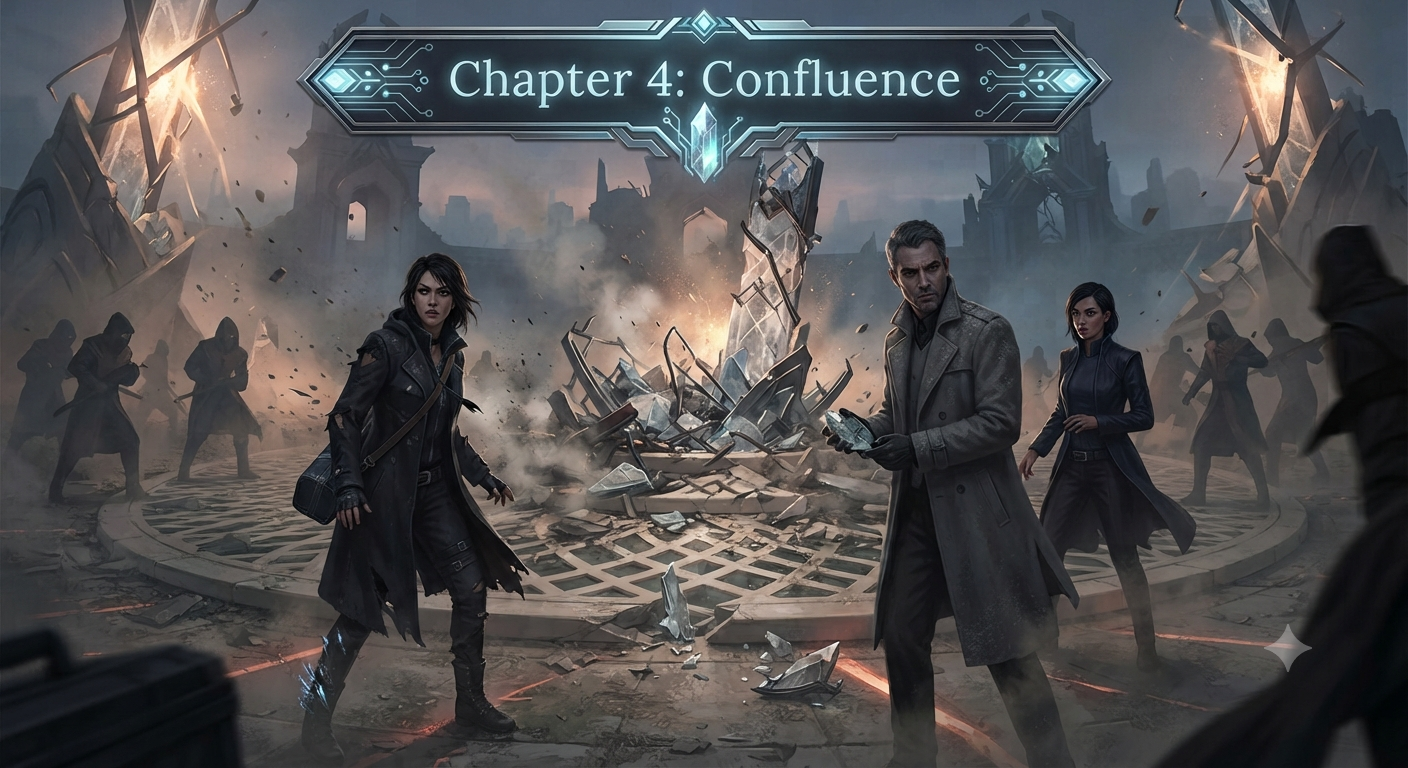
CodeBound ——— Chapter 4: Confluence
The Confluence sounded wrong.
Sable heard it before the neutral city rose above the river mist: three carrier systems sharing one foundation and pretending not to touch.
Phreaker lines sang from the western towers, bright and elastic. Hacker channels crossed beneath them in narrow, measured bands. Crypto relays held to a low pulse that seemed less like music than someone counting locks in the dark. Each system was clean on its own. Together they produced a pressure behind Sable’s teeth. And under all three, faint but steady, moved the fourth harmonic.
She shifted the tuning case on her shoulder and kept walking. Ahead, bridges converged upon a circular island of pale lattice stone. The city had no walls. Instead, three gates stood open at equal distances around its perimeter, each built in a different style and none permitted to rise higher than the others. Neutral banners snapped above the central exchange court. Conductor Halden Rusk walked beside her without appearing to watch. “You’re listening too hard,” he said.
“That is an interesting criticism from the man who taught me to listen.” “I taught you to separate signal from imagination.” “You also taught me not to insult a signal because I disliked what it carried.” His breath changed—not enough for anyone else to notice. “The western array passed inspection.” “So you’ve mentioned.” “Twice.” “Five times.” “Then repetition has failed to improve your judgment.” Sable smiled without humor. “Maybe your carrier is weak.”
Halden’s hand settled briefly on her shoulder. To the crews behind them, it would look paternal. She felt the warning in the pressure of his thumb. “Perform your duty,” he said quietly. “Nothing more.” He moved ahead to greet the neutral stewards.
Sable watched his coat disappear into the crowd. The shard hidden inside her boot hummed against her ankle. Nothing more, she thought, and entered the loudest silence in the world. The exchange court had been built around a single circular dais. Three tables curved around it, each displaying sealed cases of charged lattice crystal. Phreaker stock caught light in long internal threads. Hacker cuts held precise planes and angles. Crypto wafers looked almost plain until one noticed that no two reflected the same face.
The guilds called the exchange a gesture of trust. Every case had been counted, witnessed, sealed, and surrounded by armed representatives. Trust, apparently, required excellent inventory control. Sable delivered her tuning case to the Phreaker table and began checking the western carrier posts. She kept her movements routine: palm to crystal, breath measured, one soft test phrase per node. The official tones returned exactly as expected.
The fourth harmonic returned with them. At the Hacker table, a dark-haired man had arranged six crystal pieces into two rows. He wore an auditor’s gray rather than an Architect’s black, and he studied the pieces with the concentration of someone trying to make them confess through embarrassment. He tested one with an inspection lens, wrote something in a narrow notebook, then selected a Phreaker crystal from the exchange case.
The same batch Sable had tuned before dawn. He rotated it, frowned, and tested it again. Sable crossed the space between their tables. “If you keep looking at it like that,” she said, “it may develop performance anxiety.” The man did not look up. “Crystal has no performance anxiety.” “That one does now.” “It has a phase irregularity.” Her smile vanished. “Where?”
That earned his attention. His eyes were gray, steady, and annoyed by the existence of imprecision. “You are with the western delegation.” “You inferred that from my coat, the tuning case, or your famous mastery of obvious structure?” “From the way you crossed a marked boundary without asking.” Sable looked down. A thin black line separated the tables. She stepped fully across it.
His jaw tightened. “Show me,” she said. For a moment she expected him to call a steward. Instead, he offered the crystal and lens. “Tarin Kest.” “Sable Rynn.”
Recognition moved through his face. Not personal. Guild reports. Her name had traveled into rooms she had never entered. She set the crystal against the listening ridge of her thumb. The official charge was clean. Beneath it, the wrong note trembled through the lattice. Her shard answered from inside her boot. Sable nearly dropped the crystal.
Tarin’s hand moved beneath hers without touching. Ready to catch the object, not her. The distinction was irritatingly precise. “You felt something,” he said. “Your concern is touching.” “It was not concern. You changed grip.” “And you count other people’s fingers for recreation?” “When they are holding charged lattice.”
Across the court, a woman in Crypto charcoal stood at the third table with a wafer held beneath an adjudicator’s frame. Her dark hair was pinned without ornament. Everyone around her seemed arranged by invisible rank: clerks behind, guards to either side, a severe older woman half a pace forward. The adjudicator turned her wafer toward the light.
For an instant three small arcs appeared within it. The pattern aligned with the crystal in Sable’s palm. Not visually. In rhythm. Three intervals, each waiting for the others. The fourth harmonic rose. Sable and Tarin spoke at once. “This batch—” he began. “Where was this grown?”
A neutral bell struck over them. The ceremonial execution was beginning. Stewards closed the exchange cases and directed the delegations toward the dais. Tarin took back the crystal. “I need that,” Sable said. “It belongs to the audit set.” “It belongs to my batch.” “Then your guild has already transferred custody.” “You make theft sound restful.” “You make custody sound optional.”
A second bell struck. On the dais, three ceremonial officers took their places around a waist-high crystal column. A Phreaker cantor faced west. A Hacker formalist stood north. A Crypto witness waited east, one hand raised above a seal plate. The demonstration was deliberately simple. The cantor would carry a greeting through the lattice. The formalist would shape it into three ribbons of light above the court. The witness would authorize the ribbons to persist for one minute—long enough for every delegation to applaud its own contribution. Sable had seen the rehearsal plans. Nothing about them should have been dangerous. The cantor drew breath.
The first phrase left his mouth in a clean rising tone. The carrier posts answered. So did something underneath them. Sable’s skin tightened. “Stop.” No one heard her over the court.
The fourth harmonic caught the cantor’s phrase and returned it half a beat late. The echo entered the crystal column beside the original signal. Light climbed the lattice in two opposing spirals. The Hacker formalist hesitated. That was enough.
His transformation began around both signals. One spiral divided into three ribbons as intended. The other folded through the same structure backward, turning the return condition into an opening. The Crypto witness struck the seal plate. Authorization flashed across the dais. Every crystal in the exchange cases answered. The court became white noise and flying glass.
Sable hit the ground as a carrier post split above her. The upper half did not fall. It hung in the air, caught between two instructions, then snapped sideways into the crowd. She rolled, came up on one knee, and shouted a deflection tone. Her voice caught the post’s shriek and bent it upward. Metal passed over three crouching delegates close enough to lift their hair.
Around the dais, the ribbons of light had thickened into cutting bands. They swept through banners, tables, and stone without deciding what they were meant to transform. People ran toward all three gates. Their panic entered the open carrier network as hundreds of broken signals. Noise fed the echo. “Sable!”
Halden stood near the western table, holding a collapsing post in resonance with two other Phreakers. “Close the network!” If they closed it now, every voice already inside the carrier field would rebound toward the dais. “The court is loaded,” she shouted. “Close it!”
A child had fallen beside the neutral benches. His mother fought against the crowd moving away from him. Sable heard the shortest route between them. Not a line. A path through pressure: under the Hacker band, across the failing west channel, between two pulses of the echo. She planted both hands on the lattice and sent a narrow carrier phrase into the floor. “Follow my voice.”
The words traveled where she aimed them. The child lifted his head. Then the path buckled. A cutting band crossed it, changing the open route into a closed edge. Sable forced more breath into the phrase. The band resisted. Form held its boundary with all the warmth of a locked door.
A second voice entered beside hers. “Preserve the corridor,” Tarin said. He stood ten paces away, one hand pressed to a cracked boundary mark. Blood ran from his temple. His voice carried no trained resonance, but the structure of the phrase was exact. The band shifted. Not open. Defined.
Sable felt his containment take shape around her route: two edges, a fixed width, a beginning at the child and an end at his mother. A cage, if she listened badly. A channel, if she listened well. She adjusted her pitch to its dimensions. The carrier path snapped clean.
The child slid across the lattice as if pulled by a strong current. His mother caught him and fell backward around him. Tarin stared at Sable. She stared back. Neither of them had planned that. The dais cracked.
A pulse threw Tarin off his feet. Sable caught the edge of his containment before it collapsed and carried it outward, wrapping the nearest civilians in a curved pocket of still air. He rolled, found another boundary, and spoke a correction.
She knew where it needed to go before he finished. His forms gave the chaos edges. Her carrier moved those edges through the noise. Separately, each correction would have broken under the next echo. Together, they held long enough for people to escape. It was infuriating. It was also working. “Left post,” Tarin called. “I can hear it.” “Then why is it falling?” “Because you’re distracting me.”
She struck a descending vibration with a sharp countertone. The post veered into an empty table. Tarin almost smiled. A Crypto command cut across the court. “Withdraw authorization!”
The young adjudicator Sable had noticed stood at the edge of the dais, arguing with the ceremonial witness. Up close, her restraint looked less like calm than a blade kept sheathed by choice. “I cannot,” the witness said. “The seal is valid.” “It is attached to the wrong relation.” “The three contributors are authenticated.” “The execution they authorized no longer exists.”
Another pulse struck the court. The white ribbons converged above the crystal column, forming a shape too bright to see. The adjudicator looked directly at Sable, then at Tarin. “Break your corridor on my mark,” she said. Sable laughed once. “Absolutely not.”
“If you keep it open, the warrant will treat it as part of the ceremonial form.” Tarin’s gaze moved across the lattice. “She’s right.” “Of course you’d say that.” “I frequently do when people are right.”
The adjudicator placed both hands on the seal plate. Her voice lowered, but the words carried with a weight Sable felt in her joints. “This warrant names three acts that are no longer present. I refuse their persistence.” The seal resisted her. Blood appeared beneath one of her fingernails. “Now,” she said. Tarin released his boundaries. Sable cut her carrier. For one terrifying breath, the civilians stood exposed. The adjudicator twisted her hands apart. The authorization shattered.
The bright shape above the dais collapsed inward. Tarin threw a final containment around the crystal column. Sable caught the implosion’s scream and drove it straight up. The roof banners tore free. Then the court went silent.
Not quiet. Silence had texture. This was absence: hundreds of people holding breath beneath a network that no longer knew what to carry. A fragment of crystal clicked against the floor. Then another.
Guild guards surged toward the dais. “The Phreaker carrier doubled the command,” someone shouted. “The Form opened the return condition!” “Crypto authorized it!”
Accusations crossed faster than aid. Halden reached Sable and seized her arm. “What did you do?” “Kept people alive.” “With a Hacker form.” “With a useful form.” His grip tightened.
Across the broken court, Architect Edrin Korr stood over Tarin. The older man said something Sable could not hear. Tarin’s posture became more exact with every word. The Crypto adjudicator faced the severe Sealwarden. Unlike Tarin, she did not answer. She simply watched the woman take possession of the fractured seal plate.
Three conversations. Three authorities closing around the same evidence. Beneath Sable’s boot, the hidden shard vibrated. The fourth harmonic had not vanished. It ran through the ruined dais, the split carrier posts, the blackened boundary marks, and the confiscated seal. One failure expressed in three different accents. Sable pulled free of Halden.
Tarin was already looking toward the exchange tables. So was the Crypto adjudicator. “The crystal,” Tarin said across the distance. “The warrant pattern,” Sable answered.
The adjudicator stepped between two guards. “Nera Voss.” Her introduction sounded less like courtesy than a decision about what they were now permitted to know. She looked at the ruined execution, then at the two of them. “That containment was never authorized,” Nera said. Sable glanced at the civilians it had saved. “It happened.” “Yes.” Nera’s eyes settled on the cracked dais. “That is the problem.” Around them, every guild continued blaming the others. Under their voices, the fourth harmonic sang on.