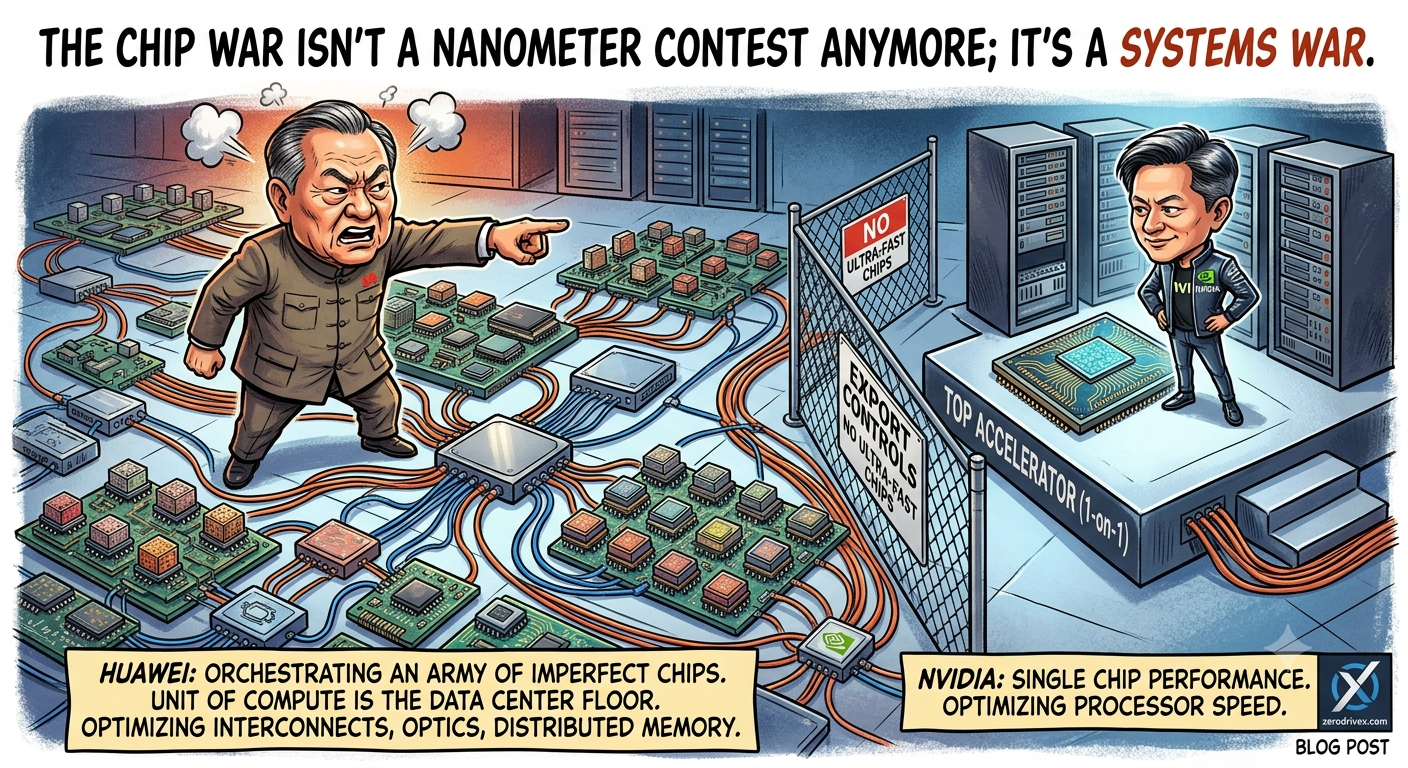
Forget the Nanometer D!@#-Measuring Contest. Thel Chip War Just Became a Systems War.
ZeroDriveX
September18,2026
For the last four years, tech media has covered the US-China semiconductor clash like two bench-pressers arguing over who has the higher one-rep max: Who has the smallest nanometer process? Who can print the fastest single piece of silicon?
That entire framing is dead.
At Huawei’s Connect conference in Shanghai, they didn't take the stage to claim they magically built an Ascend chip that beats Nvidia’s top-tier accelerator in a sterile 1v1 benchmark. They didn't because they haven't. But the real takeaway is much wilder:
Huawei is designing around the reality that they don’t actually need to beat Nvidia’s silicon to stay in the fight.
The "One Million Chips" Flex
Huawei dropped their new Peerium architecture, designed to coordinate up to one million processors into a single unified computing pool. They backed it with an overhauled UnifiedBus interconnect layer, pushed hard on nested parallelism, and accelerated their silicon timeline: the Ascend 960DT (training) is slated for Q1 2027, and the 960PR (inference) hits in Q3.
Are they hitting production constraints? Absolutely. Their internal demand is outpacing factory capacity, forcing them to hoard silicon for mainland infrastructure. Nvidia still holds the crown jewel—the CUDA moat and direct access to leading-edge foundry tooling.
Huawei isn't trying to out-forge the blacksmith anymore. They’re building a bigger engine out of whatever steel they can get their hands on. Instead of treating the individual processor as the strategic weapon, they’re treating the entire data center as the computing unit.
What Happens When You Corner Engineers?
The US export controls were built on clean, straightforward logic: bleeding-edge AI models require bleeding-edge GPUs, which require hyper-complex extreme ultraviolet (EUV) photolithography machines. Choke off the tools and the chips, choke off frontier AI.
It’s logical. But containment is not stasis. When you tell a massive ecosystem of hungry engineers, "You cannot have the magic chip," they don't sit down and cry. They look at the board and ask:
*"If our single chip is 30% slower, can we wire thousands of them together so efficiently that the latency difference stops mattering?"*
That sounds simple on paper. Anyone who builds distributed systems knows it's pure agony in practice.
In massive AI clusters, raw compute isn't your only bottleneck. Data movement is. Accelerators sit idle waiting on memory transfers. Nodes choke waiting on adjacent nodes. Synchronization tax eats your throughput alive. If your interconnect sucks, adding another 10,000 chips doesn't give you 10,000 chips worth of compute—it gives you an expensive space heater that spends 70% of its day waiting on packets.
Huawei’s answer isn't just silicon fabrication; it’s an architectural workaround. Near-packaged optics, UnifiedBus, SuperPoD clusters, and now Peerium are all brute-force attempts to eliminate the communication penalty of running massive armies of "good enough" chips.
Nvidia’s Mirror Image
Here is the irony: Nvidia reached the exact same architectural conclusion, just from the opposite direction.
Jensen Huang didn't turn Nvidia into a multi-trillion-dollar monster just by making beefy GPUs. He did it by buying Mellanox, building NVLink, engineering liquid-cooled rack-scale compute (NVL72), and locking down the CUDA ecosystem. Nvidia started with the world's most dominant silicon and expanded outward into the data center.
Huawei, locked out of that silicon pipeline, is working inward from the data center to bail out their silicon.
Both giants are arriving at the same battleground: The rack is the new chip. The data center is the new motherboard. The network is the internal bus.
Where This Actually Goes
We're staring down four very real possibilities:
- The Physics Wall Wins: Huawei’s system-level tricks fail to overcome poor yields, raw thermal limits, power draw, and memory availability. Leading-edge silicon stays king, and the hardware embargo holds the line.
- Architecture Trumps Silicon: Distributed memory, optical interconnects, and cluster scheduling advance fast enough that raw per-chip performance becomes secondary for enterprise training workloads.
- The Bifurcated AI World: We split into two computational hemispheres. The West runs CUDA and high-end Western platforms; China and non-aligned markets run self-sufficient Huawei stacks. The foundational math remains the same, but the silicon substrates diverge completely.
- The Workaround Leaks: Architectural tricks invented purely out of survival inside a constrained environment eventually leak back into global standard engineering. When someone figures out how to run million-node distributed topologies without melting down, everyone copies it.
Huawei’s million-processor claim is an architectural benchmark target, not a verified production reality today. Don't buy the corporate marketing at face value.
The direction of travel is unmistakable. The chip war isn't about single dies anymore—it's about who builds the most resilient, hyper-scaled system around the silicon they actually have.