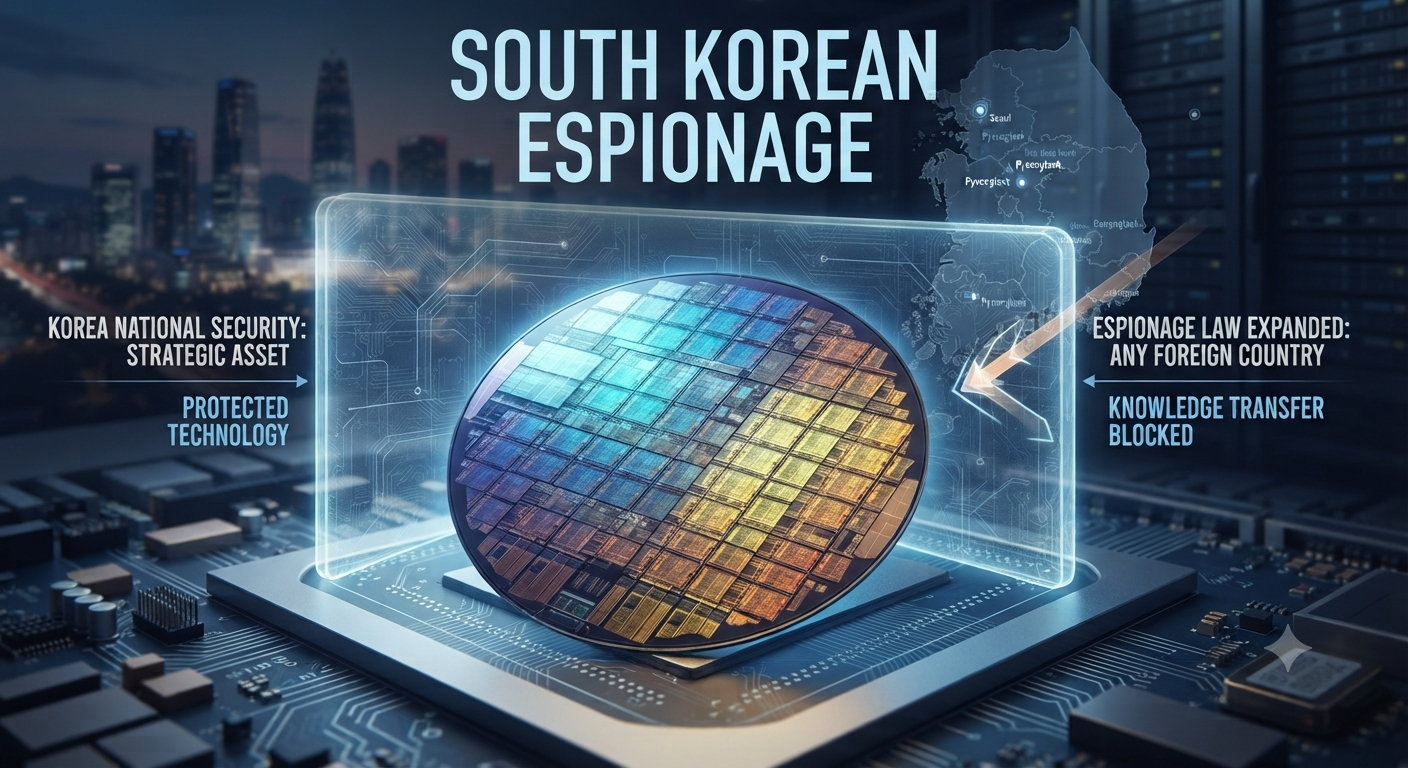
When Chip Knowledge Becomes a National-Security Asset
South Korea changed the legal meaning of espionage on September 13.
The country’s revised espionage law took effect Sunday, expanding offenses that had historically centered on activity benefiting North Korea to cover espionage involving any foreign country. The timing matters. Seoul is explicitly tightening protection around semiconductors and other strategic technologies while competition over AI infrastructure, advanced memory and chip manufacturing intensifies.
This is not happening in isolation.
South Korea sits at a critical point in the global AI supply chain. Samsung Electronics and SK hynix are central suppliers of the memory technologies feeding modern accelerators and data centers. In June, Samsung and SK hynix announced plans for an enormous new semiconductor complex in southwestern Korea, while Korean companies separately outlined an AI-data-center buildout reaching 18.4 gigawatts by 2035. Earlier this month, Seoul said semiconductor investment was also part of ongoing discussions with Washington as the United States considers new chip tariffs.
And just days before Korea’s law took effect, Belgian authorities disclosed that they had detained a former senior semiconductor executive on suspicion of transferring sensitive gallium-nitride technology to a Chinese company. The allegations have not been proven in court, but the case illustrates exactly why governments are rewriting the boundary between commercial secrets and national security.
Something larger is changing here.
For most of the information age, we tended to divide valuable knowledge into fairly familiar categories. Governments had classified information. Companies had intellectual property and trade secrets. Universities published research. Engineers changed employers. Supply chains crossed borders because efficiency usually mattered more than nationality.
AI is eroding those neat divisions.
A process recipe for high-bandwidth memory is commercial knowledge, but it can determine whether a country can supply the accelerators needed for frontier AI. Advanced packaging expertise may live inside a private company, yet it can become a bottleneck for national compute capacity. A manufacturing engineer’s accumulated practical knowledge may never appear in a classified document, but moving that expertise across a border can have consequences measured in years of industrial development.
The strategic asset is increasingly not just the chip. It is the ability to make the chip.
That distinction changes almost everything.
Export controls can restrict a finished accelerator. Tariffs can influence where a fabrication plant gets built. Investment rules can block an acquisition. But manufacturing capability is distributed across people, process knowledge, equipment settings, materials science, packaging, yield optimization and thousands of small engineering decisions.
You cannot put all of that in a shipping container and inspect it at customs.
This is why Korea’s expanded espionage law is more consequential than a narrow criminal-law amendment might suggest. It reflects a world in which governments increasingly treat private technological capability as part of national power.
The same transformation is visible in energy policy. Korea’s planned semiconductor and AI expansion is forcing the country to think simultaneously about fabs, data centers, transmission capacity, water and nuclear generation. The technology stack no longer ends at software or silicon. It extends downward into power plants and upward into law, diplomacy and security.
AI is effectively pulling previously separate systems into one strategic machine.
There are several directions this could branch.
One path is a much more explicit system of technological blocs. Countries could continue trading broadly while creating tightly controlled circles around advanced semiconductors, AI models, manufacturing equipment and critical materials. The relevant question would become less “Who is our trading partner?” and more “Who is inside the trusted technology perimeter?”
Another branch is more complicated. Companies may respond by compartmentalizing engineering knowledge much more aggressively. Access controls that once protected databases could expand into manufacturing workflows, model-development environments and even the internal movement of employees. Zero-trust architecture would stop being primarily an IT concept and begin shaping industrial organizations themselves.
There is also a paradox here.
The harder countries try to protect technological knowledge, the more valuable independent alternatives become. Restrictions can slow diffusion, but they can also create enormous incentives to reproduce the restricted capability domestically. Semiconductor history already contains plenty of examples of nations turning dependency into industrial policy.
AI accelerates that incentive because compute is no longer simply another technology market. It increasingly influences scientific research, military systems, industrial automation, intelligence analysis and economic productivity. A government that believes advanced compute will shape several of those domains simultaneously has a strong reason to avoid permanent dependence on another country’s supply chain.
That does not mean the world inevitably splits into sealed technological camps. The semiconductor industry is extraordinarily interconnected, and rebuilding every layer domestically would be ruinously expensive for most countries. Korea itself demonstrates the contradiction: it wants stronger protection for domestic technology while simultaneously attracting foreign investment and selling into global markets.
So the more interesting possibility is a world that remains interconnected but becomes selectively distrustful.
Open where efficiency demands it. Closed where capability becomes strategic.
That is a much messier system than globalization or decoupling. A Korean memory chip might serve an American AI company using equipment incorporating technology from several allied countries, while governments separately restrict which engineers, facilities, customers or jurisdictions can access the knowledge behind it.
The product can remain global even as the process becomes guarded.
For years, the geopolitical conversation around technology concentrated on who possessed the most advanced chips.
Korea’s move points toward the next question.
Who possesses the knowledge required to keep making them?
In an AI economy, that knowledge is beginning to look less like ordinary corporate property and more like strategic infrastructure.