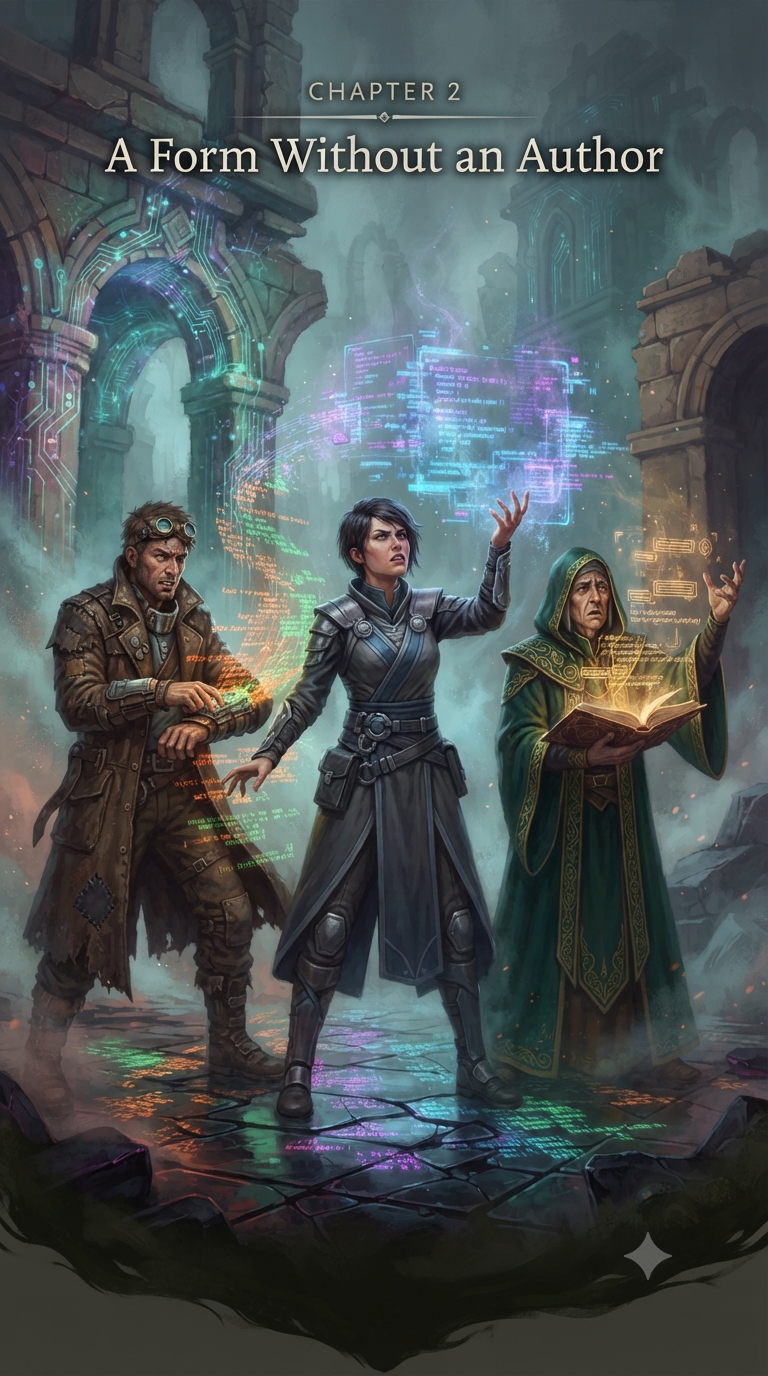
CodeBound Chapter 2
Tarin Kest knew the transformation was wrong before it began.
This was a sanctioned civic form, performed by an accredited team in the east repair hall before two dozen witnesses and an Architect who had personally approved the sequence three years earlier. The old floodgate assembly had to be shifted six inches west so the city crews could remove a fractured drainage channel beneath it.
It was ordinary work.
Expensive, public, and ordinary.
The kind of work that made institutions feel immortal.
Tarin stood at the rear of the hall with his hands folded behind his back, watching the form take shape over the gate. The gate itself was a slab of dark metal sunk into a floor of pale lattice stone. Its surface had been scored by weather and old repairs, but the structural marks set around it were clean: boundary marks at the four corners; transformation marks along the hinge-side seam; a containment loop pressed into the surrounding floor with powdered crystal and iron-gray binding chalk.
Three technicians occupied the points of the working triangle. Tarin’s attention narrowed. There. A space.
Not a gap in the chalk. Not a smudged line or a weakly cut groove. The form had a missing clause. It should have come after the permitted change and before the return condition. A narrow structural statement, so commonplace that most auditors stopped consciously seeing it after their first year of training: the clause that told a transformed object what remained continuous when its position changed. Its identity as the same gate.
Tarin unfolded his hands. “Stop,” he said. The lead operator did not stop.
That was not entirely her fault. The form had already entered its committed sequence. A spoken interruption at the wrong moment could fracture the containment loop and turn a six-inch correction into an uncontrolled release of stored pressure beneath the assembly. So Tarin did not repeat himself. He watched.
The lead operator completed the final line. For one perfectly measured breath, nothing happened. Then the floodgate moved. It did not scrape. It did not groan. The slab simply loosened from the floor, rose a finger-width into the air, and slid west across the lattice stone with the smooth, terrible confidence of something obeying instructions it should never have received.
The repair hall exhaled as one body. The gate settled into its new position. The boundary marks dimmed. Someone near the front laughed softly, with relief. Tarin did not. The gate was six inches west. It was also wrong. The new seam along its eastern edge did not meet the stone cleanly. The difference was small—less than the width of a thumbnail—but it was not an error of placement. The gate had arrived where it had been told to go. The room around it had not entirely agreed that it belonged there. Edrin Korr stood above them in a severe black coat, one hand resting lightly on the rail. He was a narrow man, spare in every line except his attention. His face gave nothing away when people looked to it for reassurance, which was why people did it so often. “Record the shift,” Edrin said. “Begin physical verification.” The repair crew began their inspection. Measuring rods clicked against the new seam. A counterweight line was tested. The old flood channel beneath the gate was opened in stages. Everything behaved. For three minutes and twelve seconds. Then the gate moved back. No command was spoken. No technician touched the lattice. The slab gave a violent shudder, sliding east across the floor hard enough to throw the kneeling inspector backward. The western seam snapped shut. The eastern seam reopened. For an instant the metal was in both positions at once: one edge seated in the corrected channel, the other still locked into the old one. Then the gate slammed back into its original place. The containment loop flared white. One of the technicians cried out and stumbled clear. The powdered crystal around the loop blackened in a thin, smoking ring. A hairline fracture ran across the lattice floor from the gate’s eastern hinge to the nearest boundary mark. Edrin descended the iron stairs with the precise pace of a man who never hurried because other people were expected to make room for him. He stepped around the blackened containment loop and studied the gate without bending. “The team will clear the hall,” he said. The lead operator opened her mouth. “Now,” Edrin added. The room moved. Technicians gathered tools with more force than necessary. Someone began to ask whether the flood channel should be resealed; Edrin dismissed the question with a glance. Within a minute, the repair hall held only three people: Tarin, Edrin, and the operator, who remained beside the gate with her shoulders rigid. Edrin turned to Tarin. “Your assessment?” Tarin looked at the gate. There were ways to answer questions like that. Most of them involved giving an Architect the conclusion he had already prepared to accept. “The identity-continuity clause was absent,” Tarin said. The operator stared at him. “It wasn’t.” “It was.” “I spoke the full form.” “You spoke the approved recital.” Tarin looked toward the marks around the gate. “The clause is embedded in the inherited pattern. It did not appear in the active structure.” The operator frowned. “That isn’t possible.” “No,” Tarin said. “It is not.” Edrin’s gaze sharpened. Tarin crouched near the gate without crossing the containment line. The fracture in the lattice floor had already stopped glowing, but it held a faint, dry shimmer. He took a thin inspection lens from his inner pocket and set it over the nearest transformation mark. The mark expanded in the glass. At first glance, it looked ordinary: a clean sequence of boundaries, change statements, and return conditions. But the missing clause had left a shape behind, not empty exactly, but occupied by something that did not belong to any current Hacker notation. Two narrow fields lay folded inside the structure. One carried a pattern of repeating intervals, unevenly spaced. Not a boundary. Not a sequence. Not anything a Form should require in order to define a change. The other was stranger. It had no readable condition attached to it. It was a place for a condition, perhaps. A hollow in the form shaped exactly like an unanswered question. Tarin’s pulse slowed. That happened when he was frightened. His body, unhelpfully, preferred precision to panic. He had seen those fields before. Not in a sanctioned civic form. Not in anything he was supposed to possess. In the copied fragment hidden beneath the false bottom of his travel case. “You recognize something,” Edrin said. Tarin looked up. The operator had gone pale. “No,” Tarin said. Edrin did not blink. “Operator Vale,” he said, “leave us.” She looked between them. “Architect, I followed the form.” “I said leave us.” For a moment, Tarin thought she might refuse. He almost wished she would. Instead, she gathered her gloves from the floor and walked out without another word. The door closed behind her. Edrin waited until the sound of her steps had faded. Edrin looked down at the gate. “And you are certain a required clause was absent.” “Yes.” “Yet the transformation completed.” “For three minutes.” “It completed.” Tarin drew a slow breath. This was the trap in Edrin’s best arguments. He never stated the false thing. He placed two true things beside each other and waited for someone less careful to bridge the distance between them. “The gate moved,” Tarin said. “That is not the same as completion.” “A form can produce an outcome without resolving the state it has changed. The gate moved six inches west. The structure did not establish continuity between its prior position and its new one. It held under an assumption that was not expressed.” “An assumption supplied by what?” “I don’t know.” “Then you do not know that the clause was absent.” “I know what was not there.” “You already knew something was wrong,” he said. Edrin’s eyes lifted to his. “Explain.” “You saw it before I spoke. You knew the form had a gap.” “No.” “You ordered physical verification before anyone checked the active structure.” “I ordered verification because that is procedure.” “You did not ask to inspect the form.” “The gate had moved. The gate needed to be tested.” “That is not an answer.” “No,” Edrin said. “It is an instruction. You will document this as an operator error pending a full review. You will not circulate your preliminary assessment.” Years ago, in a training hall smaller than this one, Tarin had pointed out a mismatch in a sanction form. A subtle reversal in the order of two conditions. His instructor had dismissed it without looking closely. The exercise proceeded. An apprentice named Lio Maren had taken the recoil through one arm and lost the use of three fingers. The official finding had been user error. Tarin had been told that insisting otherwise would only make Lio’s recovery harder. He had learned then that institutions did not always lie by saying the opposite of the truth. Sometimes they simply narrowed the field until only a convenient truth remained. “Architect,” Tarin said, and heard the care in his own voice. The more dangerous he believed a conversation to be, the more exact he became. “If the problem were operator error, the form would show a break at the point of deviation. It does not. The active structure contains two fields that modern notation cannot define.” Edrin went very still. There it was. Not surprise. Recognition. Tarin’s stomach dropped. “You will leave the hall,” Edrin said. “What are those fields?” “Leave the hall.” “They are inside every inheritance pattern, aren’t they?” Edrin’s expression hardened by less than a degree. Tarin almost regretted saying it. Almost. The Architect moved past him to the damaged gate. He lifted a hand over the fracture in the lattice stone, not touching it. The air around his fingers seemed to settle. “You have always had a gift for noticing what does not belong,” Edrin said. “It is not the same as understanding what should be done with it.” Tarin’s throat tightened. “You trained me to inspect what others overlook.” “I trained you to protect people from unstable structures.” “By pretending this one is stable?” “By preventing a room full of frightened technicians from inventing theories they are not equipped to test.” “That is not what I am doing.” “No,” Edrin said. “You are doing something more dangerous. You are deciding that because a pattern unsettles you, the entire foundation must be suspect.” Tarin looked at the gate, at the fracture, at the dead black ring where containment had burned itself out. “The foundation is suspect.” “Leave,” the Architect said. Tarin did. He walked out of the repair hall with his inspection lens in one pocket and the shape of the two impossible fields fixed behind his eyes. No one stopped him in the corridor. That was the thing about orders given by powerful people: they traveled ahead of you. Technicians looked away. Two junior auditors ceased their conversation when he passed. At the far end of the corridor, he heard the heavy mechanisms engage as Edrin sealed the repair hall behind him. By evening, the official report had already appeared on the civic board. Minor containment instability during approved floodgate correction. Probable operator deviation. No structural risk to public works. Tarin read it twice. Then he went to his rooms, locked the door, and opened the false bottom of his travel case. Inside lay a strip of lattice crystal no longer than his hand. It was clouded with age, its edges chipped, its internal geometry so dense that looking at it too long made his eyes ache. Lines crossed lines, then vanished under other lines. Structures nested inside absences. There were no names for most of what it contained in modern Hacker instruction. Tarin set it on the table. For several minutes, he did nothing. Then he placed his inspection lens over the fragment and adjusted the focus. The old fields appeared. One: an uneven pattern of intervals, folded into the form like a route no map acknowledged. Two: a hollow shaped for an authority the form could not generate by itself. He took his notebook from the case and opened to a page he had never allowed anyone else to see. There, in careful ink, were copies of the same fields. Six years of failed interpretations. Questions made more precise, then crossed out. Theories abandoned because they explained only one detail and distorted five others. Now he added a new line. Civic floodgate form: same embedded fields active during reversal. He stopped. Below it, he wrote: The sanctioned form did not fail because it lacked structure. It failed because its structure depended on something it could not name. The sentence looked too large on the page. Tarin closed the notebook. Outside his window, a bell sounded from the central square: one measured note, then another. The Confluence delegations would begin arriving tomorrow. Phreaker carriers, Crypto seal-readers, neutral observers, civic representatives—every guild dressed in its confidence, every guild prepared to demonstrate why it could be trusted with the part of the world it understood best. The Confluence had been a professional obligation. Now it was evidence. Crystal batches from all three guilds would be exchanged there. Inspected. Logged. Set beside one another in a way the separate archives never permitted. If the same hidden fields existed in the crystal patterns of other disciplines— He stopped the thought before it could become a conclusion. Conclusions were what people used to stop looking. He wrapped the fragment in oilcloth and returned it to the hidden compartment. Then he packed the case properly: clothes, notebook, tools, travel papers. Nothing that would suggest urgency. Nothing that would invite a search. At the doorway, he paused. The official report sat folded on the worktable. Tarin considered burning it. Instead, he slipped it into his coat. A record could be false and still be useful. Sometimes the lie told you where someone had decided the truth could not be allowed to go. He extinguished the lamp, stepped into the corridor, and locked the room behind him. Before dawn he passed through the eastern gate aboard a narrow civic coach, his travel case braced between his boots. The Hacker quarter diminished behind him into straight black lines. Ahead, the Confluence road bent with the river, refusing every clean geometry the city had imposed upon it. The Confluence was three days away. Before Edrin could erase the evidence, Tarin intended to learn what kind of form could move the world without knowing who had written the rest of it.