Chapter 3: The Seal That Signed Itself
Nera Voss knew the signature was genuine.
That was the first problem. The second was that the man who had made it had been dead for eleven years. She sat alone at the adjudicator’s table while rain marked the high windows of the Hall of Claims. Across from her, two families occupied opposite benches and avoided looking at one another. Between them rested a narrow cedar box containing the disputed binding: three sheets of vellum, a lattice wafer no wider than a thumbnail, and enough inherited resentment to outlive everyone in the room.
The claimant, Mara Iven, wanted possession of a riverside workshop. The opposing family maintained that her warrant had expired with its signer, Master Orrel Dane. Neither argument mattered if the seal was false. Unfortunately, it was perfect.
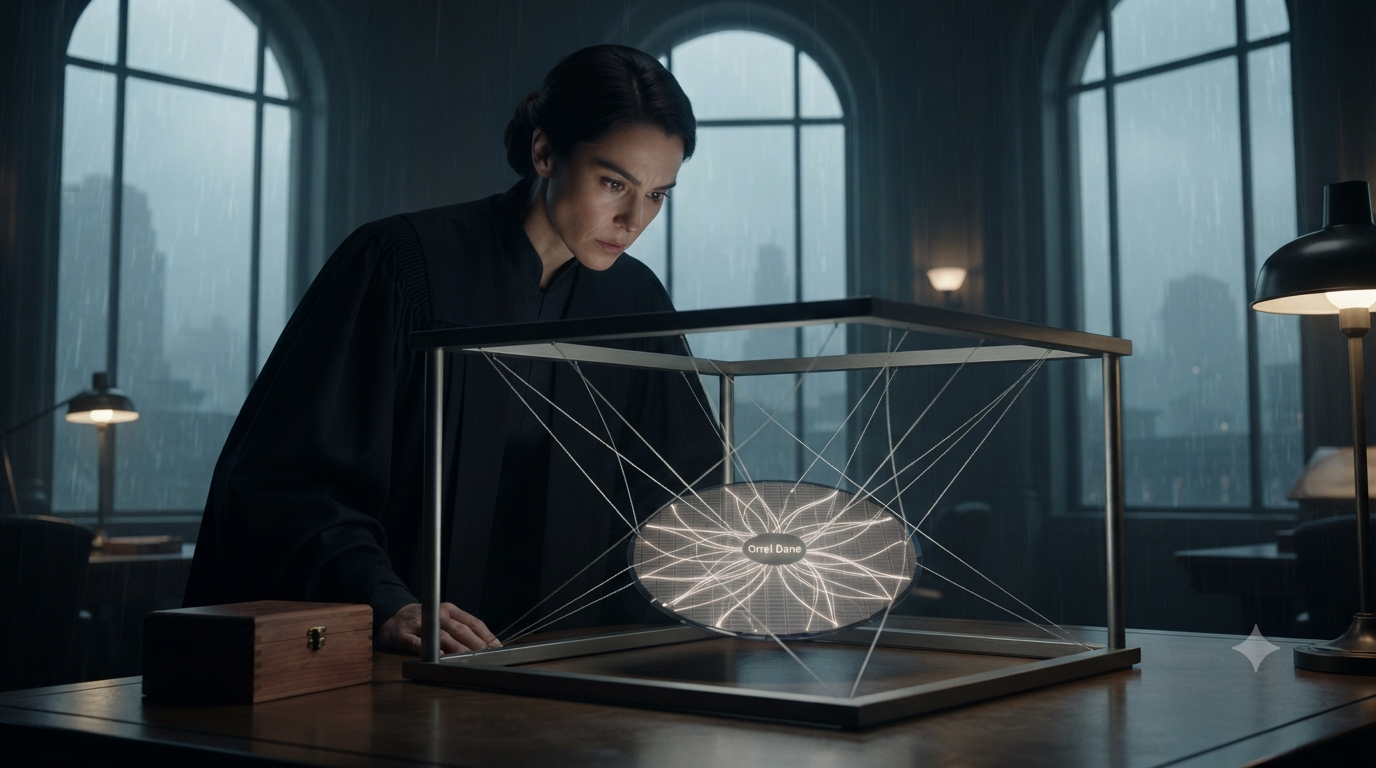
Nera lowered her inspection frame over the wafer. Eight silver threads descended around it without touching. At her first spoken phrase, they drew taut. “Present the claim.” Mara stood. “Orrel Dane grants the workshop, its tools, and its water access to Mara Iven upon completion of seven years’ service.” “Present the objection.”
A gray-haired man on the other bench rose. “Orrel Dane died before the seventh year. The transfer was never completed.” Nera watched him rather than the seal. He believed what he said. Mara believed the opposite. Belief proved nothing, but relationships often betrayed the pressure placed upon them.
“Who witnessed the original binding?” “Two journeymen,” Mara said. “Both names are recorded.” “And both are dead,” the gray-haired man added. Of course they were. Dead witnesses were wonderfully disciplined. They never contradicted the people speaking for them.
Nera placed two fingers against the adjudicator’s plate. The crystal was cool and inert. “By whose identity does this claim persist?” The seal answered. Not in a voice. Her spoken inquiry traveled into the lattice; the warrant returned its relations as pale lines inside the wafer, joining identity to promise, promise to witness, witness to consequence. The pattern was exact. Provenance intact. No substitution, broken custody, or counterfeit pressure appeared anywhere in the chain.
At its center shone Orrel Dane’s identity.
Nera examined the date twice.
The seal had renewed itself nine days ago.
A murmur moved through the benches. They could not read the pattern, but they could read her silence.
“Clear the hall,” Nera said.
The clerk beside the door hesitated. “Adjudicator?”
“Clear it.”
Both families protested at once. Nera let them. Outrage spent in public was usually cheaper than outrage allowed to mature in private. The clerk ushered them into the outer gallery and closed the bronze doors.
Nera waited until the last footstep faded. Then she asked the seal, “Under what living authority was renewal granted?” The pattern tightened. Orrel Dane. She changed the question. “Whose present consent sustains this claim?” Again: Orrel Dane.
The result was not merely unlikely. It was relationally impossible. A dead identity could remain attached to a completed promise. It could not renew consent, accept a new consequence, or answer for a changed circumstance. Death did not invalidate every obligation. It ended the person’s ability to choose. Crypto doctrine was explicit on that point, although powerful houses occasionally developed selective memories.
Nera rotated the wafer beneath the frame. There was no fracture. Its geometry showed no foreign insertion. Every custody transition carried the proper countermark. If someone had forged it, they had not imitated Dane’s identity. They had persuaded the lattice that Dane was still capable of choosing. She whispered the test for living presence. The silver threads contracted. The seal validated. Nera withdrew her hand.
For the first time that morning, she looked toward the observation screen above the chamber. The dark glass reflected only the adjudication lamps, but someone would be listening. Important claims were never unattended. They were merely observed by people who preferred not to become witnesses. She returned to the wafer and separated the outer warrant from the identity chain one relation at a time. Near the lowest edge, beneath the journeymen’s attestations, a mark emerged. Three arcs surrounded an empty center.
One arc was scored like closely spaced waves. Another turned inward through a sequence of sharp joints. The third remained unclosed, its final line stopping before it could claim the whole circle. Nera forgot the room.
Her mother’s damaged seal lay hidden beneath a loose stone in Nera’s rooms. It bore the same three arcs. One broken. One scraped nearly smooth. One ending before closure. For thirteen years, Nera had known the arcs named all three guild lineages as independent witnesses. No modern Crypto record admitted that such a compact had existed, and every archive trail she followed ended in a gap bearing Ysra Pell’s custody mark.
The mark inside Dane’s warrant was smaller and complete. She reached for a recording slip. The observation screen opened. Sealwarden Ysra Pell entered without haste, dressed in the unadorned charcoal of high custody. She carried no ceremonial chain. She never needed objects to remind a room who held authority over it. “Nera,” she said.
Not Adjudicator Voss. Not before the clerk. Not before the claimants. The use of her given name converted a public proceeding into a private obligation. Nera left the recording slip untouched. “Sealwarden.”
Ysra crossed to the table and looked down through the inspection frame. Her expression did not change when she saw the dead man’s identity. That was more informative than surprise would have been. “What did the claimants tell you?” Ysra asked. “That the workshop transfer was disputed.” “And your determination?” “The seal is authentic in form.” “Then there is no dispute.” “It renewed nine days ago.”
Ysra’s eyes moved to her. “The original warrant may contain a persistence provision.” “It does not.” “You have not completed your examination.” “I completed that portion first.”
A faint pressure entered Ysra’s silence. Nera had lived beneath that silence after her mother vanished. It had taught her how many refusals could be delivered without a single explicit no. Ysra bent over the wafer. “The seal validates.” “Yes.” “Under the named identity.” “Yes.” “Then record it as valid.”
Nera folded her hands. “Orrel Dane cannot consent.” “The binding does not ask you whether you approve of the signer’s circumstances.” “Death is more than a circumstance.” “To the living.”
There it was: not an evasion, but a principle. Ysra believed custody existed precisely because relationships were unreliable. A valid chain mattered more than the wishes people later attributed to the dead. Nera looked through the frame again.
“A warrant can be authentic and still authorize what its signer never chose.” “That distinction is a luxury in stable times.” “What has become unstable?” Ysra’s gaze rested on her for one measured breath. “You are adjudicating a workshop.” “No. I am adjudicating whether the dead may create new consent.” “You are adjudicating what the record can establish.” “And the record establishes an impossibility.”
Ysra lifted the cedar box and placed the vellum inside. Last came the lattice wafer. Her movements were careful, precise, almost respectful. “This claim is transferred to high custody,” she said. “On what ground?” “Jurisdiction.” “Whose?” “Mine.”
Nera felt anger arrive as clarity. It simplified the room. “The families require a ruling.” “They will receive notice that the instrument is under review.” “Will it be reviewed?”
Ysra closed the box. “You are asking the wrong question.” “Then give me the right one.”
The Sealwarden’s hand remained on the lid. “Ask what happens when confidence in legitimate warrants fails. Contracts become arguments. Identity becomes whoever has the larger escort. Every promise is relitigated by whoever survives the person who made it.” “And if confidence is preserved by validating the dead?” “Then we investigate without frightening people who cannot help us.” Us. A relationship offered and imposed in the same syllable.
Nera glanced at the hidden mark. “Have you seen that geometry before?” Ysra followed her gaze. This time the reaction was visible—not fear, exactly, but a decision made too quickly. “It is an obsolete custody notation.” “From which house?” “It does not concern this claim.” “It is inside this claim.”
Ysra removed the wafer from the frame. The silver threads went slack. “Nera.” Her voice softened. “Questioning a particular warrant is your duty. Teaching a room full of frightened claimants that validity itself is negotiable is something else.” “Crypto itself?” Nera asked. “If you prefer the dramatic phrasing.” “I prefer accurate phrasing.” “Then be accurate. You found no forgery.” Nera looked at the closed box. “I found something worse.”
Ysra’s face became still. “You found a valid warrant. Record that fact and nothing beyond it.” The warning was clear because it never became a threat. Threats created evidence. Ysra dealt in obligations. She carried the box toward the private exit. “What happened to my mother’s cases?” Nera asked.
Ysra stopped. Rain whispered against the windows. “This is not about Elian,” she said. Nera had not used her mother’s name. “No,” Nera said. “Apparently it is not.” Ysra left with the disputed seal. The bronze door closed, and the hall seemed to reclaim its dimensions. Nera remained at the table until the clerk looked in through the public entrance. “Should I recall the parties?” “Tell them high custody has assumed the claim.” “On whose petition?” Nera almost admired the question. Clerks understood that authority without paperwork was merely appetite wearing formal clothes. “Sealwarden Pell’s.” The clerk wrote it down. After the families had gone, Nera returned the inspection frame to its cabinet and signed the room ledger. She recorded the instrument as authentic, its disposition transferred, its adjudication incomplete. Every statement was true. The report was also a lie. At dusk she entered the copying room beneath the Hall of Claims. Officially, adjudicators used it to reproduce damaged marks for archival comparison. Unofficially, every surface had been designed to reveal unauthorized work. The door logged identities. The lamps recorded duration. Even the warming plate retained the order in which impressions were made. Nera signed in under her own name. Secrecy worked best when it borrowed the posture of permission. She placed a blank impression leaf on the warming plate. She had no wafer to copy, no authorized tracing, and only memory to guide her. Memory was considered unreliable evidence. That did not make it useless. With a bone stylus she drew the first arc: the close waves. The second: the jointed line. The third: the curve that stopped before closure. Her mother’s seal had taught her the shape. Dane’s had supplied what damage had obscured. Where the arcs approached the empty center, Nera added the tiny relation marks she had seen beneath the lens. The leaf resisted. An impression was supposed to receive a warrant, not invent one. She adjusted the heat and spoke the narrowest authorization she could defend. “I record what I directly witnessed, for comparison only. No claim attaches. No identity is invoked.” The leaf softened. Lines darkened across its surface. For an instant, the three arcs seemed to lean toward one another while refusing to meet. Then a fourth mark appeared at the center. Nera had not drawn it. It was not a signature. It resembled the place where three signatures might be tested against one another. She lifted the leaf from the plate before the room could register a second attempt. The mark faded, but not completely. Nera slid the impression inside her sleeve and cleaned the stylus twice. On the ledger she recorded one comparative exercise, inconclusive, no instrument retained. Again, every statement was defensible. Again, the whole was false. Outside, evening bells marked the opening of the Confluence roads. Delegations would already be moving toward the neutral city: Phreaker crews with their tuned crystal loads, Hacker auditors with their sanctioned forms, Crypto custodians carrying warrants no outsider would be permitted to inspect. Ysra would expect Nera to travel with the official house party in the morning. Nera returned to her rooms, lifted the loose stone, and set the unauthorized impression beside her mother’s damaged seal. The marks matched. Not approximately. Not as two symbols from the same tradition might resemble each other. The arcs shared proportions, breaks, and relational intervals. Dane’s warrant carried a complete version of the compact her mother had left damaged. Someone had not forged Orrel Dane’s identity. They had made an old relationship answer in his place. Nera wrapped both impressions separately and hid them in the lining of her travel coat. She packed no more than official duty required. Excess preparation looked like intention, and intention was the first thing a skilled custodian learned to prove. Before dawn, she joined the Crypto procession beneath the eastern arch. Ysra’s carriage waited at the front, its windows shuttered. Nera took a place three wagons behind it. The Confluence was where the guilds displayed the truths they permitted one another to see. She intended to arrive carrying one they had all agreed to forget.